Long-Billed Curlew on March Point

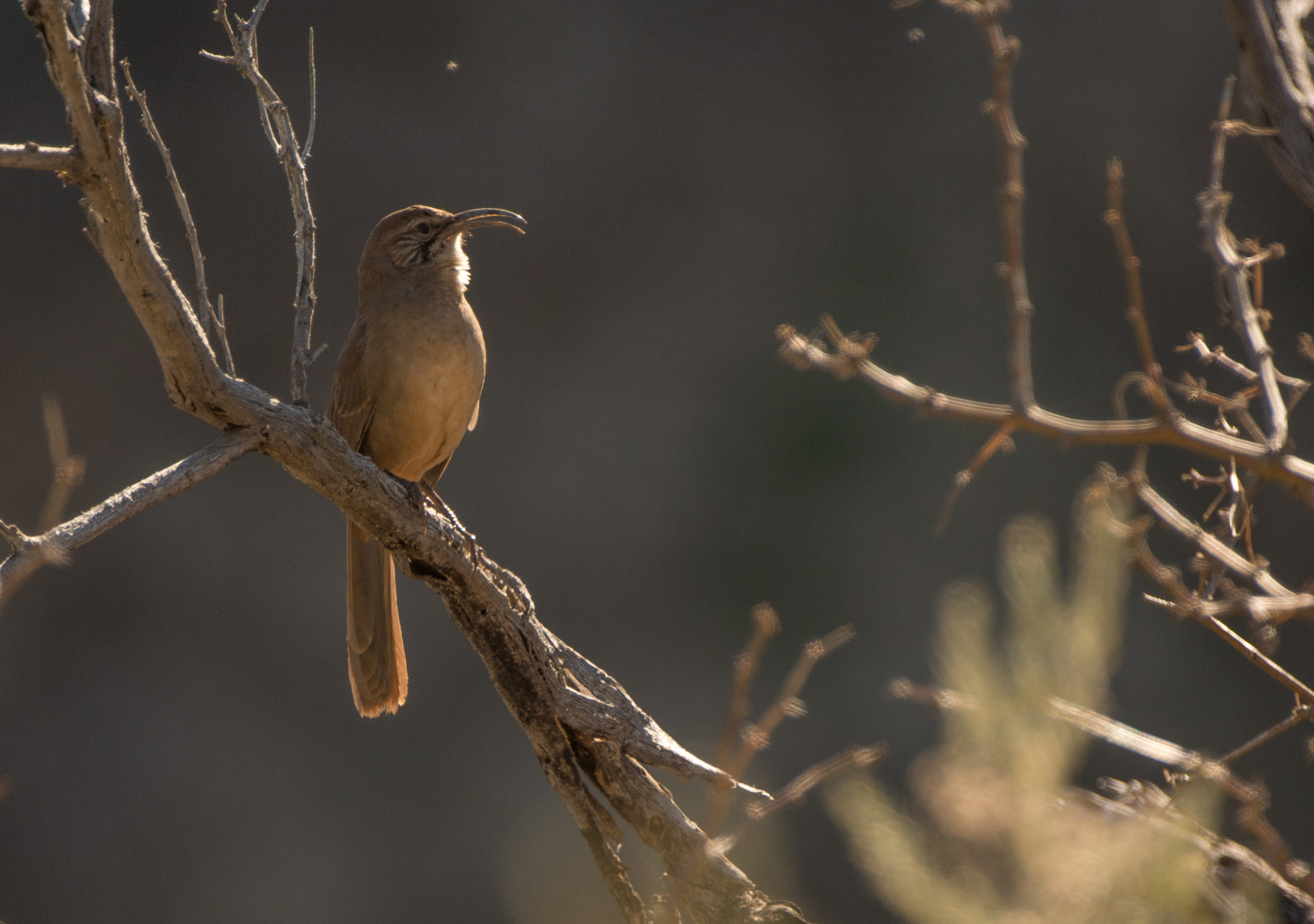
I was on my way to Mount Vernon early on the afternoon of October 21, 2015, hoping to encounter an unusual bird or two.  I wasn’t disappointed.  As I drove along the shoreline I was startled to see a Long-billed curlew standing right on the shore, only 20-25 feet from my vehicle.  I stopped and took about a dozen photos (all virtually the same) while the bird eyed me.  I eventually grew tired of the same angle and drove up the road, then circled back to see if the bird might have moved and given me a different angle.  It hadn’t.  It didn’t seem to mind my presence, and I finally left after another set of photos.

I have never seen a Long-billed curlew anywhere near this area, although I seem to remember several years ago that there were reports of three moving around in the fields of the Skagit Flats.  I made several trips searching for them but never found them.  I remember many years ago seeing over a dozen in someone’s manicured yard in one of the south Texas towns, but I felt very fortunate to be able to obtain these photos here.

In composing this blog post I started having misgivings when I checked a reference guide and saw that the Whimbrel was a very similar bird.  So I sent an email to a couple of more knowledgeable friends who provide expert advice.  One of them confirmed that the bird is a Long-billed curlew.

DSC_2519 DSC_2500

I returned on Thursday, October 22 and again found the curlew about 100 yards (as the proverbial crow flies) from where it had been the previous day.  This brought on another round of photos.

Preening…

Curlew, Long-billed 20151022-15

“Yawning”…

Curlew, Long-billed 20151022-07

And while I was photographing the curlew I noticed a small group of about five Black turnstones working the beach…

Turnstone, Black 20151022-07


Leucistic American Goldfinch

On Monday, October 19, 2015, I received a call from Linda Fleming at the Skagit Wild Bird Supply (located on Memorial Highway) that they had a leucistic American goldfinch at their feeders.  I dropped what I was doing, grabbed my camera and drove to the store to try to obtain photos.  The bird had left by the time I arrived, but it made three more appearances over the next 2-3 hours and I managed some good photos on one of those visits.

I checked in the next morning (Tuesday) and was told the bird was there again, so I went back over but two hours of observation were fruitless.  The bird has not been seen since mid-morning on Tuesday.

Goldfinch, American - leucistic 20151019-05 Goldfinch, American - leucistic 20151019-06

My Usual Clientele

I enjoy some of the special birds that visit the yard from time to time and they are the ones that most often end up on my posts.  But I fill in between those special visits with the birds that are here day in and day out.  They don’t get as much press as our special visitors but they account for the majority of my photos and help fill in between special visitors.  So in this post, in part because I had few special visitors yesterday, I’m going to showcase some of our more common visitors which I photographed on Sunday, October 11, 2015.  It will be a long list, so fasten your seat belt!

Despite the chickadees’ abundance in the yard, I usually have a difficult time photographing them.  Part of this is that they are extremely active and, except when taking food from a feeder to consume while on a limb, offer precious little time for photographs.  Another problem is that, despite their numbers, they often fly back and forth between the feeders and some obscure perch in the woods where they hammer a seed to manageable pieces.  (It’s a mystery to me why these birds can’t consume even part of a hulled sunflower seed in one swallow!)  I was quite happy with obtaining several photos of this Chestnut-backed chickadee that descended to the watercourse for a bath.

Chickadee, Chestnut-sided 20151011-01

While I’m mentioning volume, here are photos of a couple of Dark-eyed juncos of the Oregon race.  In another month or so we will have as many as thirty or so in the yard, and unless we have a major influx of Pine siskins, the juncos will be our most numerous yard birds for the duration of the winter.  In the spring most of them will leave for the higher elevations where they will breed.

Junco, Dark-eyed - Oregon 20151011-04 Junco, Dark-eyed - Oregon 20151011-01

Another common yard bird is the House sparrow, of which we probably have a dozen or more.  I would rather we didn’t have them (in part due to their gregariousness) but we have to put up with them.  However they can make a good subject for portraits.  This first bird is a male preparing to take a bath.

Sparrow, House 20151011-03I was lucky to be able to photograph this female House sparrow eating a single coral berry less than ten feet from me.  The sparrow worked her way up in the bush until she could reach the berry, and it was that movement that caught my attention.  The berry clung to the bush so the sparrow ate a little of it at a time.

Sparrow, House - eating berry 20151011-05

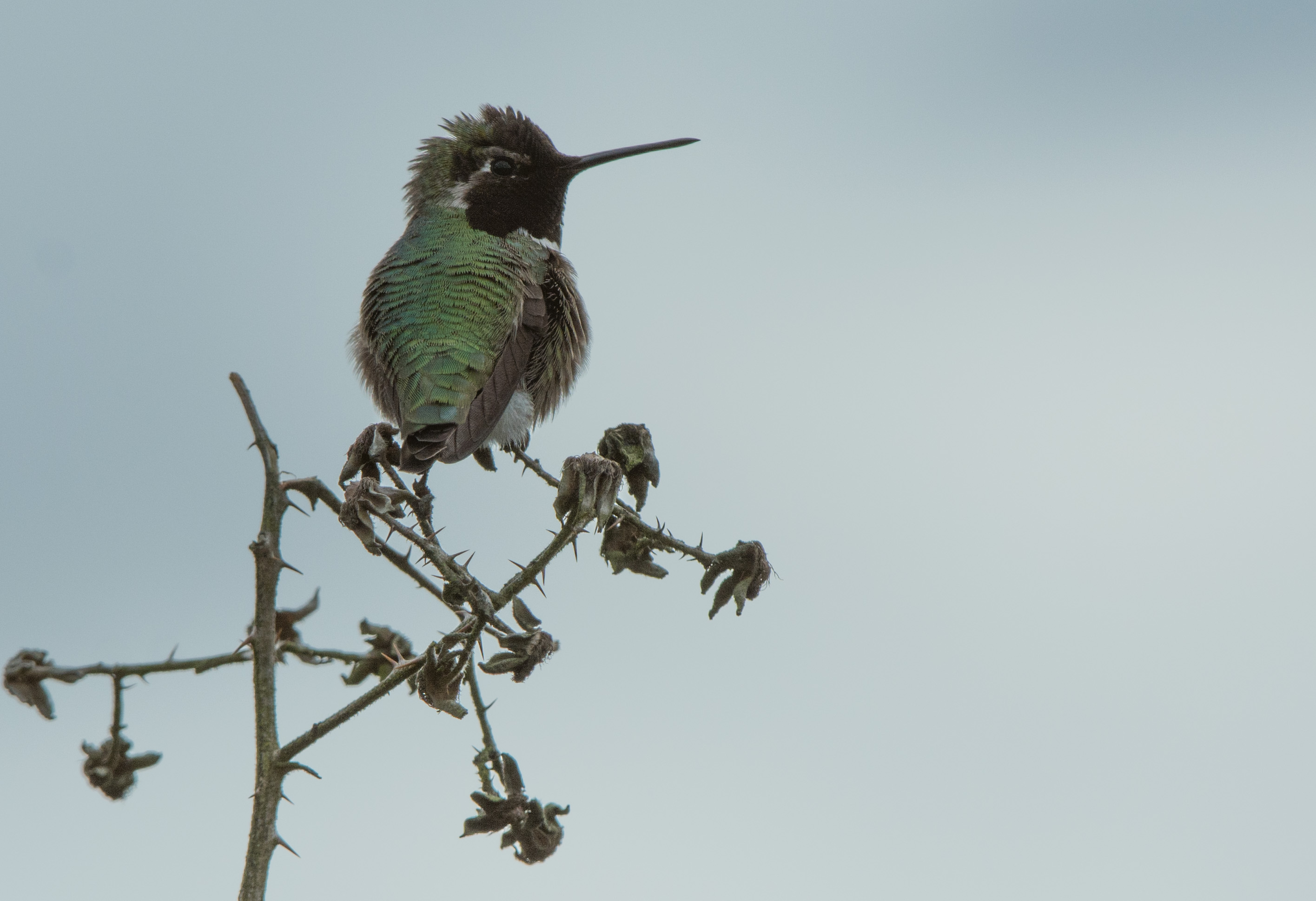
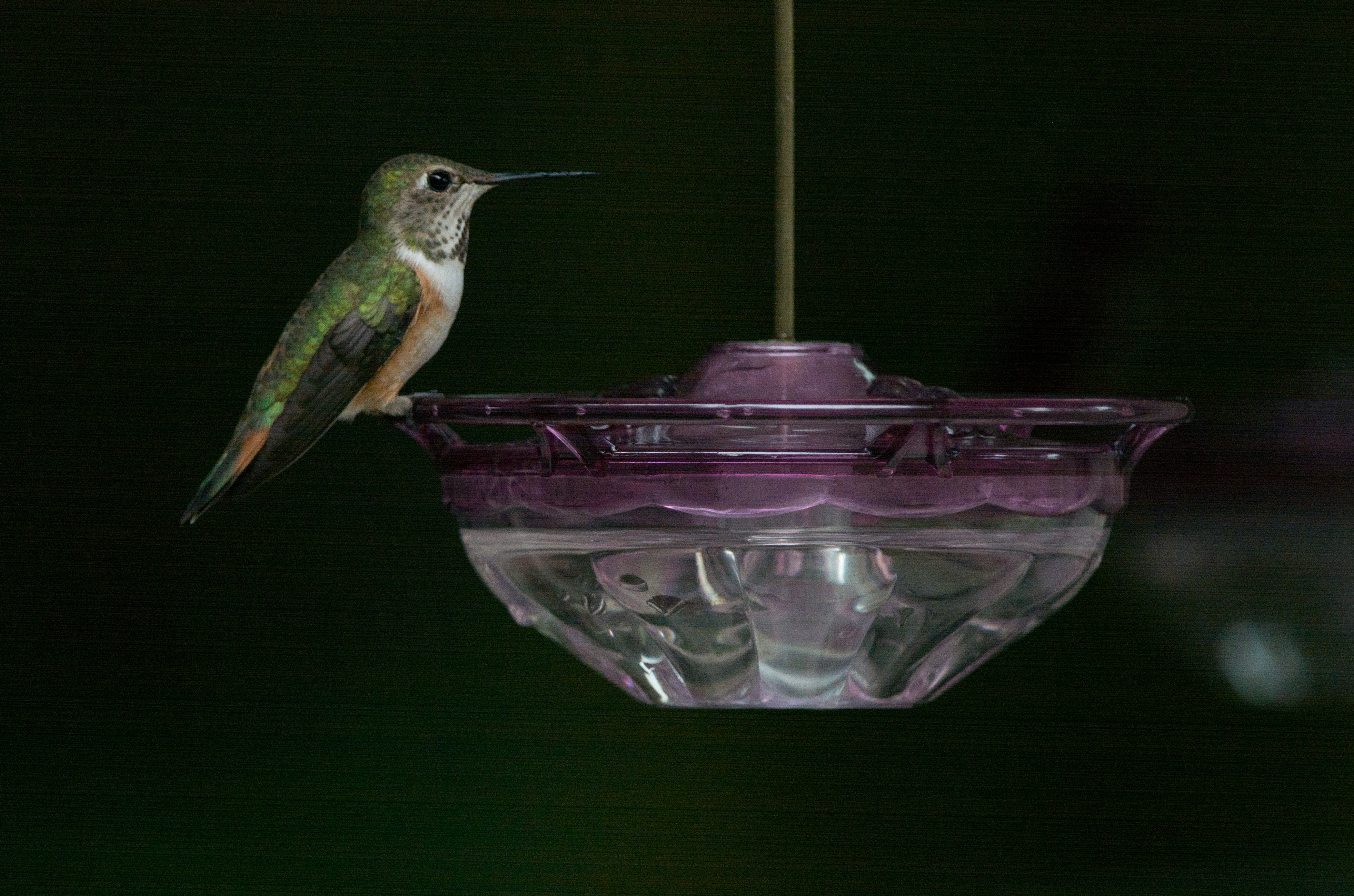
I occasionally take, but usually don’t post, photos of birds at some of the bird feeders.  On this day I had male (which appears first) and female Anna’s hummingbirds which came to the smaller feeder we use in the winter.  The background, only several inches from the feeder, is a window… which appears black in the photo.  I thought the effect was interesting and so included the photos here.

Hummingbird, Anna's 20151011-10 Hummingbird, Anna's 20151011-09

Other common visitors are the House finches, in this case a female.

Finch, House 20151011-04

We have a variety of sparrows.  In addition to the House sparrows pictured above, we will have a few Song sparrows (pictured first) and Golden-crowned sparrows (pictured second) that will over-winter in the yard.  In addition to these sparrows, I observed an adult White-crowned sparrow yesterday… somewhat of a yard rarity at this time of year.

Sparrow, Song 20151011-02 Sparrow, Golden-crowned 20151011-07

We had two or three coveys of California quail in the neighborhood this year, after neither hearing or seeing any last spring or summer.  This is a sad progression… the coveys start out with a pair of adults with 10-12 chicks and the chicks get whittled down on an almost daily basis.   If a pair raises two to three chicks to adulthood it must be considered a successful breeding season.  Strangely the quail seem to disappear for the entire winter… every year.

Quail, California 20151011-01

And after grousing (I believe in my last post) about how difficult it was to photograph the Brown creepers, I had one come to the bird bath and wait patiently on a stump while another bird bathed.  It was a rare opportunity to obtain good photos of one and I took full advantage of the situation.  If you look closely you can see the fine detail in the feathers, but looking at the bird’s back in general makes my eyes blur!

Creeper, Brown 20151011-03

And since we consider our yard a wildlife sanctuary, I don’t want to slight one of our non-avian friends… a Townsend’s chipmunk.  It’s been hanging around the yard now for several months and on rare occasions even brings a friend.  It seems to have changed its living quarters several times but keeps making trips back to the yard for food.  Does it appear that it has any food in this photo?

Chipmunk, Townsend's 20151011-09


A 237- Photo Day!

Friday, October 9, 2015, was at least our second windy day in a row. I thought that this would discourage birds from visiting the yard, but it didn’t seem to be the case so I decided to spend some time in the yard.


One of my first interesting birds was what is apparently a Slate-colored Dark-eyed junco. I thought I had seen one several days earlier but I hadn’t gotten either a good look at the bird or a photo… this day’s photos confirmed it. This makes at least eight seasons in a row that we have had at least one Slate-colored junco in the yard.

Junco, Dark-eyed - Slate 20151009-02

My next interesting observation were two or more Yellow-rumped warblers of the Audubon’s race. They made several visits to over a long period of time. I can confirm from my photos that I had at least two different individuals in the yard, but I suspect several more. At a couple of times during my observations there were two in our watercourse at the same time.

Warbler, Yellow-rumped - Audubon's 20151009-19 Warbler, Yellow-rumped - Audubon's 20151009-15

Next up was a female Purple finch, the first I had observed in our yard and only the second one I’ve seen on Cap Sante in the 15 years we’ve lived here at three different locations. There’s so much (color) variation among male House finches that I doubt my ability to distinguish between the male House and Purple finches, but the females have a broad, white wash over their eye. I’ve always thought myself a better identifier of the females of the two species. This bird was approaching the watercourse when a squirrel frightened it away and it left the yard., but fortunately I obtained a couple of photos. After the Purple finch observation I’ve been making a point of more carefully observing the male finches that visit the yard!

Finch, Purple 20151009-02

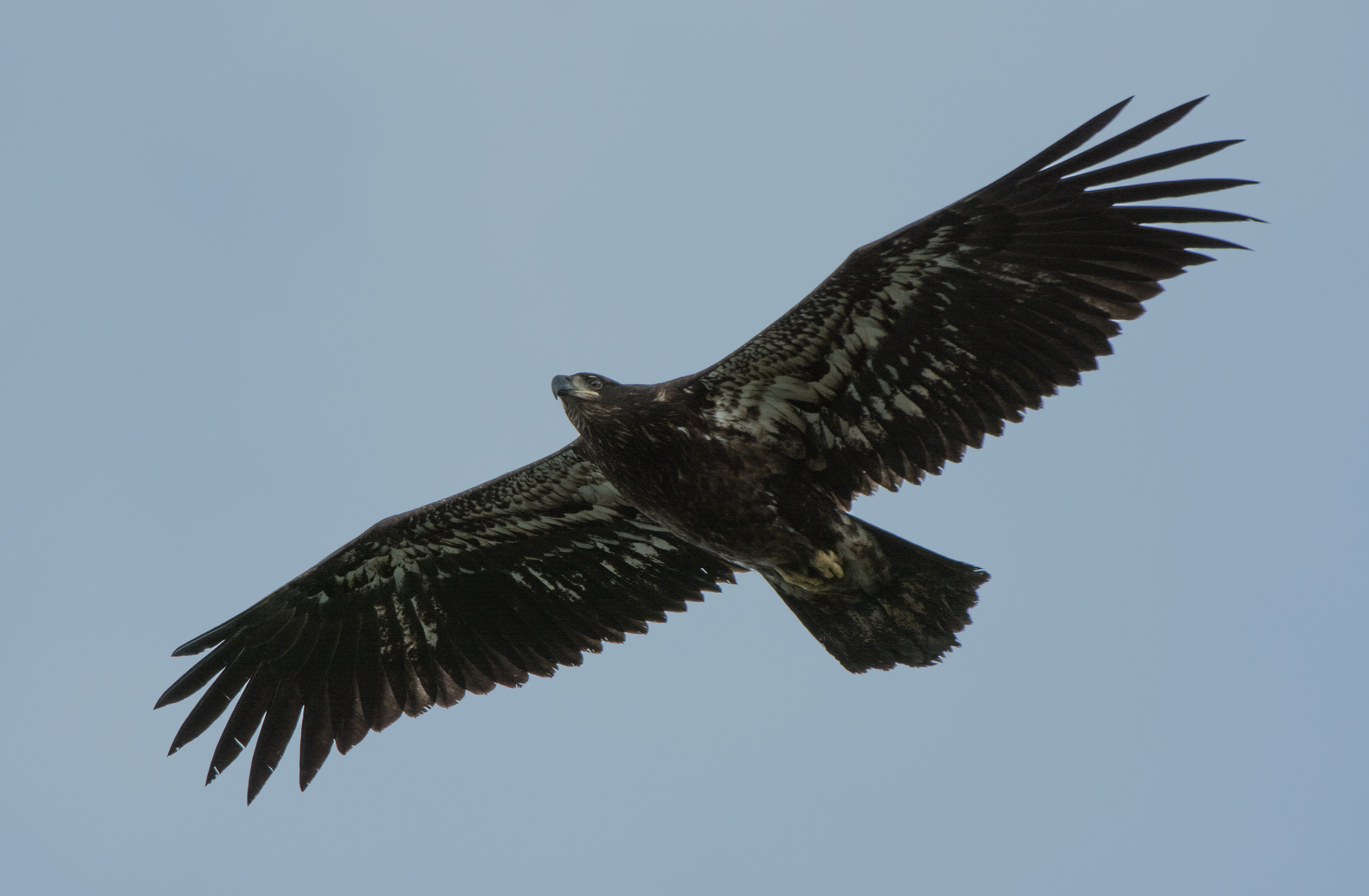
Shortly after the Purple finch sighting I noticed a bird soaring behind some of our tallest fir trees. It was circling and there seemed like the chance that it was headed my way so I had time to quickly change a couple of settings on my camera to facilitate photographs of a flying bird. I’m fairly sure the bird is a juvenile accipiter and my guess is that it’s a Cooper’s hawk. I don’t usually see these birds in the air.

accipiter 20151009-01

Later I managed to photograph a female Anna’s hummingbird feeding on our salvia. We also have at least one male and will maintain a feeder to try to help the birds through the winter.

Hummingbird, Anna's 20151009-03

Next up was a male Ruby-crowned kinglet, our second sighting of the season. It visited an alternate bird bath and I was able to obtain several photos of it.

Kinglet, Ruby-crowned 20151009-05 Kinglet, Ruby-crowned 20151009-02

Beginning to wind down now, a Brown creeper visited the same bird bath. I always have trouble photographing the creeper (I think the autofocus on the camera doesn’t deal effectively with the bird’s camouflage pattern) so a stay in the bird bath usually gives me multiple opportunities to get at least some photos with a good focus.

Creeper, Brown 20151009-05

By this time I was quite pleased with the day’s photo production and was getting ready to pack it up for the day when a female Varied thrush appeared at the watercourse unexpectedly. I took some photos of her and then decided to call it a day!

Thrush, Varied 20151009-13 Thrush, Varied 20151009-08


Golden-Crowned Kinglet and Varied Thrush

On Monday, October 5, 2015, I spent a couple of hours in the yard.  We’ve had a lot of American robins and a few European starlings using the watercourse quite frequently over the past few days, and no one loves a bath more than those two species.  While I was in the yard I also observed almost continuous visits from one or more Golden-crowned kinglets, and one finally took the bait and entered the watercourse for a bath.  I probably took in excess of 40 photos… it’s such a cute bird to photograph!  In this case this is a male, which isn’t obvious from the following three photos.

DSC_1620 DSC_1641 DSC_1643

So how do I know the bird is a male?  In this photo the bird is showing its orange crest, a feature it has difficulty hiding if it takes a thorough bath!

DSC_1657

And I believe I’ve mentioned in prior posts that we’ve had a male Varied thrush in the yard for a couple of weeks now, and this past weekend it was joined by a female.  They too are attracted by the water and I finally managed some photos of the male.  I hope to obtain better photos as the season progresses.

DSC_1674 DSC_1671