Birds for Visitors

On July 20, 2013 we had visitors arrive from Texas.  Around the middle of the afternoon one of them, a beginning birder, looked out the kitchen window and saw a Cedar waxwing in or around the watercourse.  As soon as I heard my wife confirm the sighting I grabbed my camera and headed outside, but by the time I was set up the waxwing had disappeared.  (I had thought I might have heard a waxwing earlier in the day but didn’t see it in glancing around the yard.)

We decided to set up in the yard and watch birds for awhile and in just a few minutes a male Black-headed grosbeak arrived in one of the madrona trees.  After just a little moving around the yard it was down by the watercourse, an unusual event as I believe I mentioned in one of my prior posts.)  I was able to take a good many photos of the bird staging, bathing and preening afterwards.

20130720-Grosbeak, Black-headed   20130720 005_

Male Black-headed Grosbeak

20130720-Grosbeak, Black-headed   20130720 010_

Male Black-headed Grosbeak – post-bath

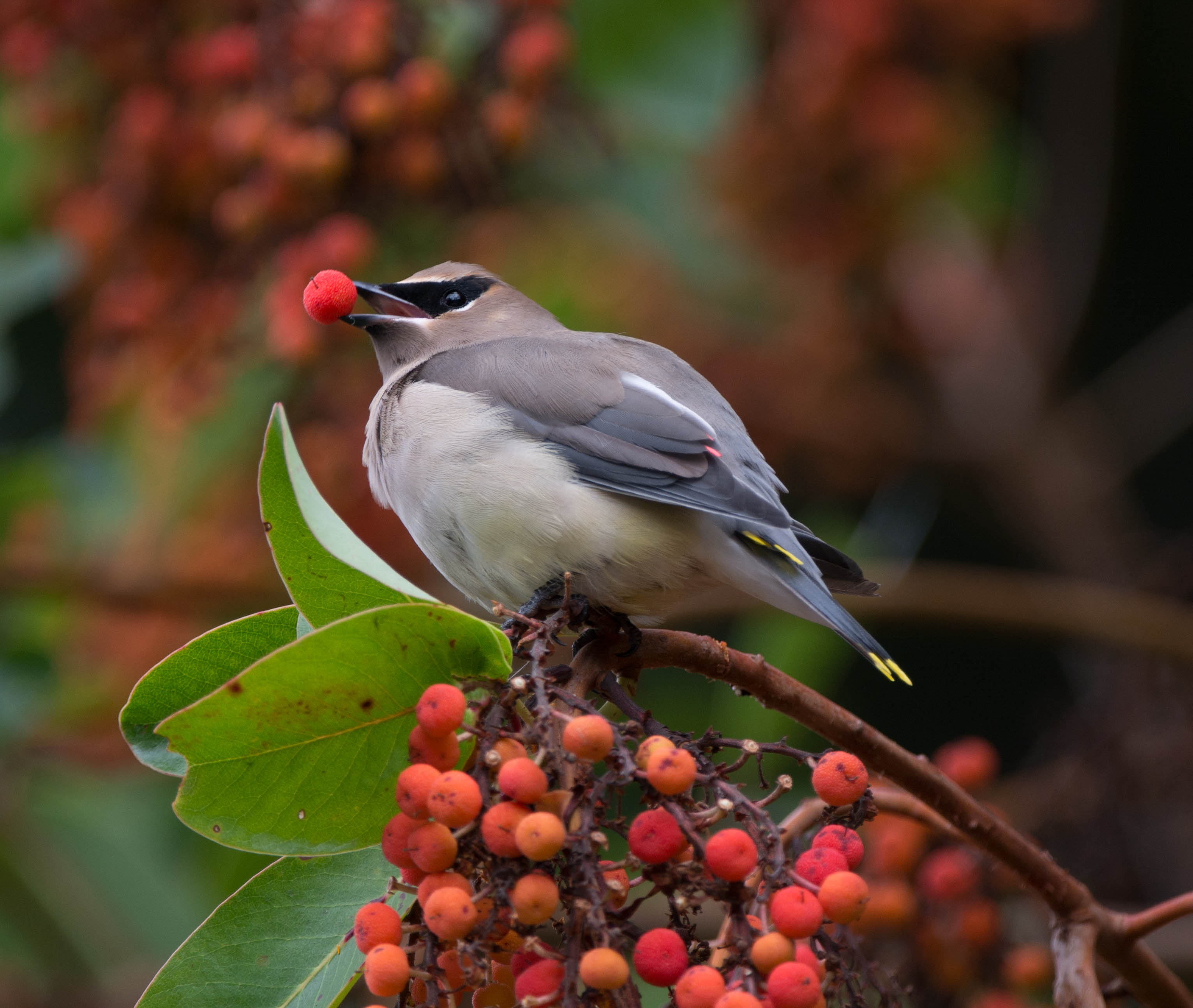
Almost before the grosbeak was finished bathing the Cedar waxwing was back and I was able to get a couple of photographs.  I suspect this might be a juvenile… crest not raised, colors not very bright and some feather aberration on the bird’s belly.  For whatever reason, at one point the waxwing decided to open its beak and I managed a photo with its mouth open.

20130720-Waxwing, Cedar   20130720 003_

Cedar Waxwing

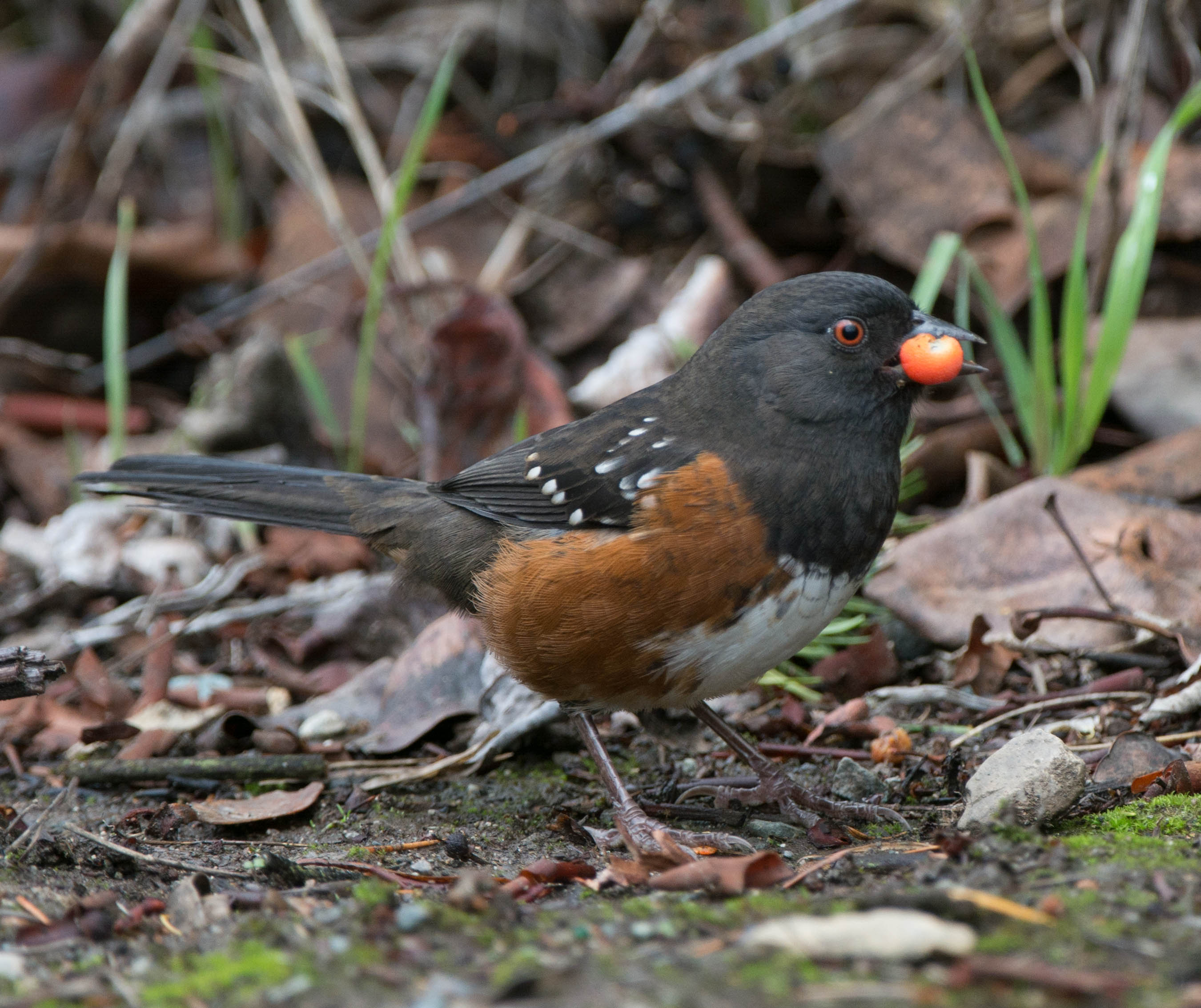
While we were watching, in about the same 10-minute period, a Spotted towhee made an appearance at the watercourse… and a while later, yet another.

20130720-Towhee, Spotted   20130720 004_

Spotted Towhee

While the towhees are regular daily, year-round visitors, the grosbeaks have been rare visitors for the past couple of months and it’s unusual for either species to visit the watercourse.  The waxwings are very rare visitors but when ithey do visit, it is usually to avail themselves of the water.

It was nice to be able not only to photograph these birds, but to show them to our visitors!


Crows

First, a couple of birds that have been in the yard lately.  The first is a Eurasian Collared dove which I believe I mentioned in my last post.  Not the greatest photo but it will do for a record shot.

20130715-Dove, Eurasian Collared   20130715 003_

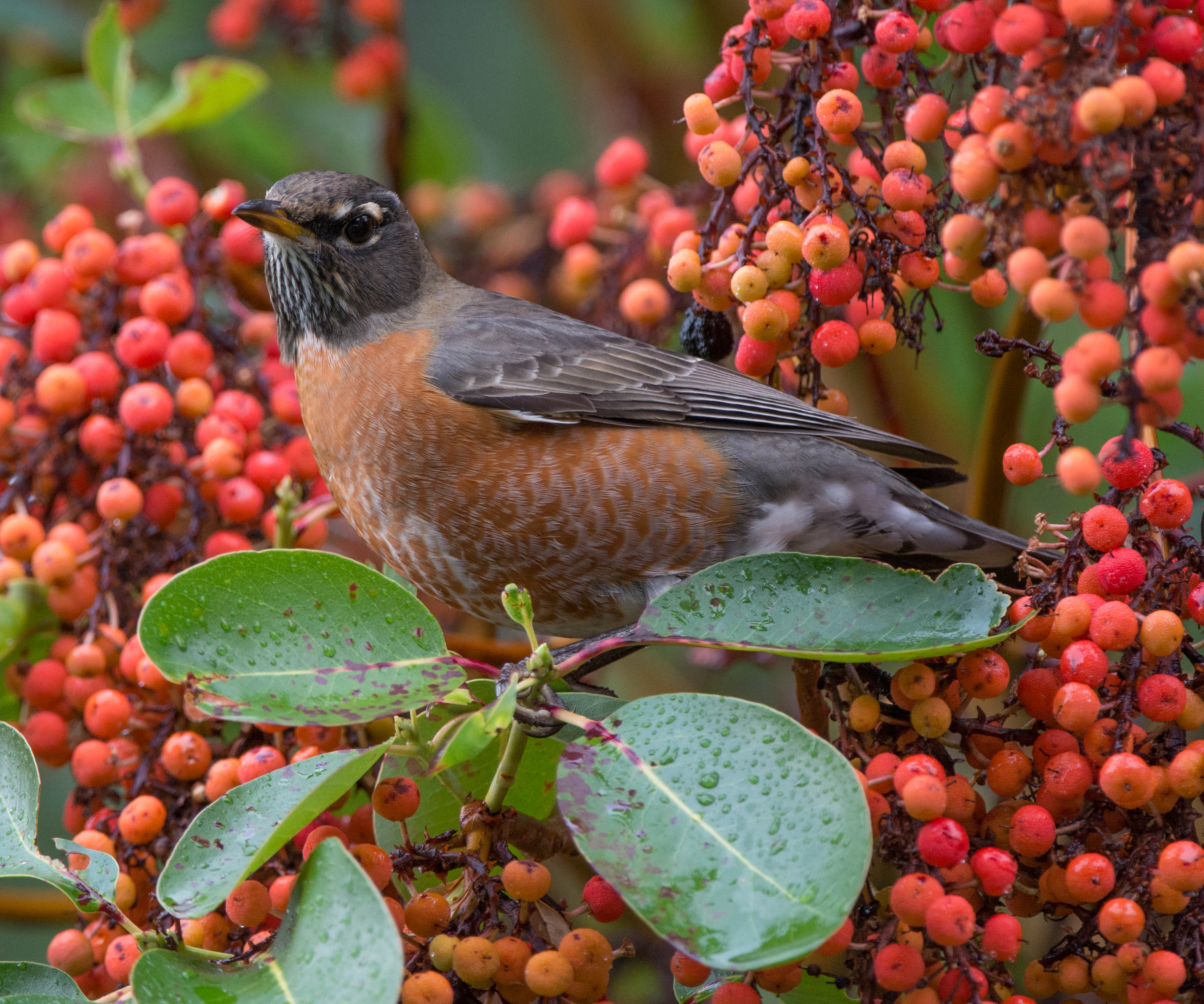
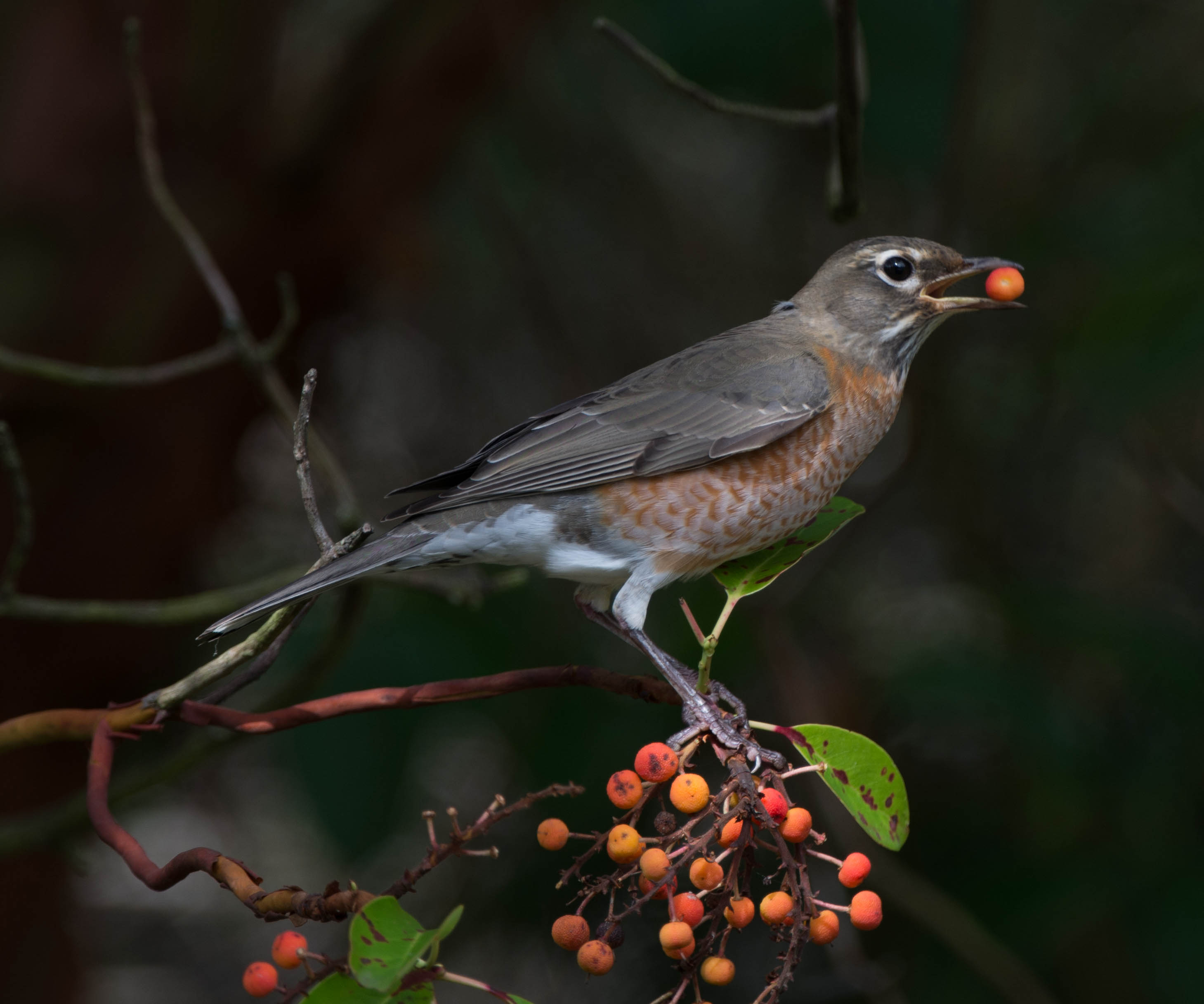
Next up… a juvenile American robin.  The bird is full-sized but the spots on its breast give it away.  However this bird is not new to the world.  It flew directly to one of the few huckleberry bushes in the yard and immediately began plucking berries!

20130717-Robin, American   20130717 004_

However, I have a tale to tell about crows.  This photo is a juvenile that, with its family, has been hanging around the yard since it fledged a few weeks ago.  The feature that marks this bird as a juvenile is the light-colored marking at the base of the bill, a trait exhibited on many other species of juvenile birds.

20130714-crow  20130714 004_

And now for the tale…

For the past two years I had occasionally driven through the local marina on the way home and selectively fed some of the crows in the parking lot.  It seemed that there were a few crows that recognized my car but all the other crows in the vicinity keyed off the actions of those few who recognized either me or my greenish-blue Honda Honda CR-V.  I never took any action to attract the crows… I always kept my hands in the car but my driver’s window was usually rolled down so that I could throw out the occasional peanut. 

On occasion I would drive in other areas of town several blocks away from the marina and the crows would clearly recognize me.  They exhibited this recognition by following my car along the street, either flying alongside or landing beside the car and watching me.  My theory was that they recognized the car and that was their key to the peanuts.  There were a couple of other Hondas in town that were exactly like mine and I often wondered what happened when/if they drove through the marina, as the crowd of crows in the winter could sometimes reach as many as 60-80. 

 When breeding season arrived in the spring of 2013 all of the crows disappeared from the marina parking lot.  The crows pair up at that time of year and spend time building nests and defending their nesting area from other crows and predators such as ravens, eagles, raccoons, etc.   So for about two months I encountered no crows in the marina parking lot. 

 In late June I drove through the parking lot a couple of times and there were a few crows (maybe 5-6 at the most) back in the parking lot.  On the first day they were back I was driving through the parking lot looking at the marina out the passenger window of my Honda when I became aware of a distraction out my driver’s window.  I turned and there were a couple of crows flying along beside the car, periodically landing and looking up at me.  This established that they retained in memory, for approximately two months without reinforcement, the fact that they could garner peanuts from the vehicle!  I thought that this was an accomplished feat which just added to my respect for these birds.  But there was more to come. 

 In late June a 2013 silver Toyota RAV-4 I had ordered about a month previously arrived at the dealership and I took possession of the vehicle.  The new vehicle replaced the 2011 Honda CR-V that was blue-green in color. 

 Although I made a few trips through the marina in my new Toyota RAV-4 after it was delivered, I saw no crows.  This was probably due in part to extensive lawn maintenance that was taking place in the area one day and the fact that the parking lot was uncharacteristically full of vehicles, the owners of which were out on boats at the beginning of the summer boating season.  Finally after some of the parking lot activity had died I made my first trip through the parking lot in my new vehicle when crows were present.  The first I saw of them was as they were flying directly towards me from almost 100-yards away!  I had no expectation that they would be attracted to the new car, as it was silver and my former car had been blue-green.  However the crows had clearly spotted me before I spotted them.  They flew directly to the new car and began their behavior that indicated they knew there were peanuts to be obtained.  Again, I made no overt actions which could have clued them.  As far as I am concerned, the only explanation is that they recognized my face from a distance of almost 100-yards! 

Summer Yard Birds

Bird sightings in the yard are, for whatever reason, somewhat less interesting this summer than last.  The Red crossbills which were with us all last summer and most of the winter have mysteriously disappeared and the Black-headed grosbeaks, normally frequent visitors to the yard and feeders are conspicuously absent this year… with a single exception which you’ll read about soon.  This year we have only a single male California quail that visits the yard… gone are the multiple covies of both sexes we’ve seen in prior years.  So that’s most of the bad news.

The good news is that for about the past week or so we’ve had both a single, apparently juvenile Mourning dove in the immediate vicinity and we’re now being visited by two Eurasian Collared doves.

20130702-DSC_3420

Juvenile Mourning Dove

Earlier this month we were visited by a single male Black-headed grosbeak and instead of checking out the feeders it went for the watercourse.  I’m not sure I’ve ever seen one in or around the watercourse or one of the bird baths, but this bird’s visit gave me many opportunities for photographs with the bird out in the open… an opportunity I almost never get.

20130703-DSC_3457

Male Black-headed Grosbeak

20130703-DSC_3471

Male Black-headed Grosbeak

On the same day as the grosbeak’s visit we were visited by a family of five Bushtits, very rare visitors to the yard.  They also visited the watercourse and I also managed many photographs, although they were eventually discouraged by House sparrows.

20130703-DSC_3488

Bushtit

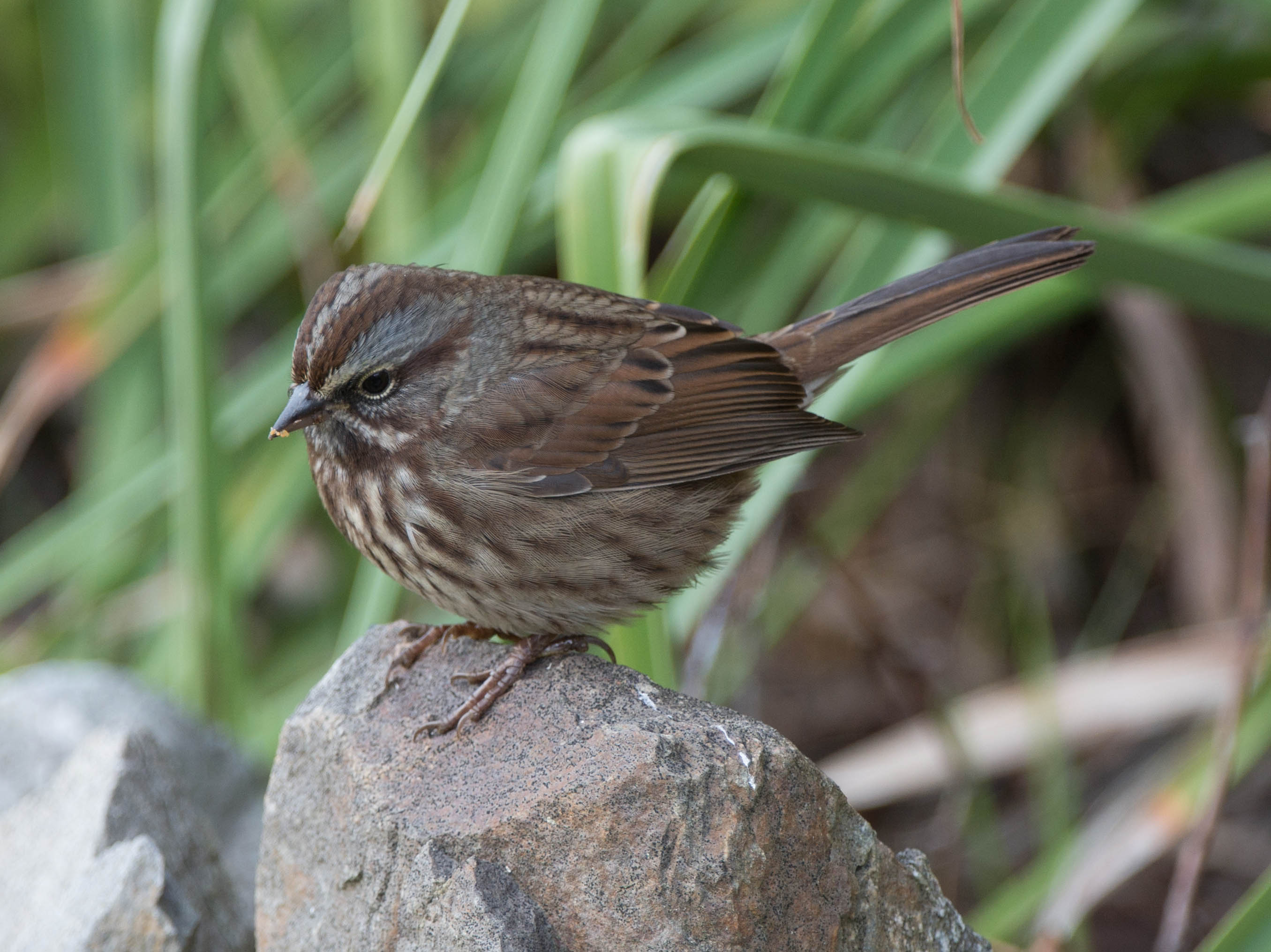
And also earlier this month I had a visitor that, when processing photos, I realized I couldn’t identify.  After consultations with better birders than I, I have about accepted that this is a Song sparrow… although unlike any I have ever seen.  The beak appears unusually elongated and it’s possible that the bird is a juvenile.

20130702-DSC_3402

Juvenile Song Sparrow?

And finally, I should mention that the crocosmia is now in full bloom which offers many opportunities for hummingbird photographs.  I use the word ‘opportunities’ because even though I can shoot a lot of photographs, it can still be difficult to obtain really quality photographs of the hummers in flight!  (This is truly a case of having to open a lot of oysters to find a pearl!)


Methow Valley – 3

Here are a few more photos taken in the Methow Valley on June 13, 2013.

First up is a female Red-winged blackbird, a bird that looks nothing like its male mate.  In the non-breeding season the sexes usually separate into their own flocks, pairing off again in the early spring.

20130613-Blackbird, Red-winged   20130613 005_

Female Red-Winged Blackbird

A male Red-naped sapsucker removing cavity materials from an active nest…

20130613-Sapsucker, Red-naped   20130613 020_

Two unidentified fly-catchers.  Some flycatchers are identifiable only by vocalizations, far beyond my capabilities!

20130613-DSC_2699 20130613-DSC_2688

This, I believe, is a Warbling vireo…

20130613-DSC_2589

And finally, another Cedar waxwing…

20130613-Waxwing, Cedar   20130613 006_

This concludes photos from the Methow Valley.  My original intent was to return to yard birds I photographed immediately after returning from the trip east of the mountains, but I had a rather bountiful day in the yard yesterday (July 3) and I’ll probably publish some of those photos next.

Methow Valley – 2

One of the highlights of the expedition, both this year and last, were a pair of Red-naped sapsuckers nesting in a tree along Beaver Pond.  This year they were in the same tree as last year, but this hole appears fresh and I think it is a few feet lower than the one they used last year… more about that in a minute.  The birds made repeated trips to the nest hole, bringing in insects and taking out wood shavings.

20130612-Sapsucker, Red-naped   20130612 003_

Female Red-Naped Sapsucker

Male Red-Naped Sapsucker

Male Red-Naped Sapsucker

There were several House wrens around the pond and it was difficult for me to tell whether, over the course of several hours, I was observing one, a pair or more than one pair.  There was often one singing… presumably a male.

20130612-Wren, House   20130612 003_

20130612-Wren, House   20130612 015_

One of the pair of House wrens appeared that they might have a nest in the hole used by the sapsuckers last year, but House wrens are notorious for building more than one nest and for dismantling the nesting materials of other birds, both of which behaviors I have observed in my yard this year.

20130612-Wren, House   20130612 013_