Never Give Up!

Crows are one of my favorite subjects.  They are very intelligent and keen observers.  This time of year the crows are transitioning from their gregarious behavior to pairing for the breeding season, which involves defending a territory and gathering nesting materials.  Last week I thought I observed a pair of crows working on a nest near my yard while I was out with my camera.  A crow landed on a dead limb on one of our fir trees and I casually noted that it was attempting to gather nesting materials. Strangely enough, I have never witnessed a crow gathering sticks from the ground… they always want to break sticks out of trees for their nests.  As I watched I saw this crow break off and drop two sticks.  Undeterred, it began wrestling the same limb for yet another stick.  Fortunately I had the  presence of mind to bring my camera to bear on its activities.

These aren’t great photographs.  I could improve them but fortunately the shutter speed was high enough (1/500 of a second) to stop most of the motion.  The shots are underexposed but I like the silhouette effect.  Here’s what I observed and photographed…

In this first photo, the crow has its back to me and is wrestling with the higher level of twig, attempting to separate it from the rest of the limb.

crow with nesting material 20150409-01

In this next photo the crow has successfully broken the small limb from the larger one, but it has lost its balance, fallen below the limb but still has a firm grip on the twig.

crow with nesting material 20150409-02

In this next photo you can clearly see that the twig has separated, but it is caught on the main branch.  The crow, despite being upside down, is determined to come away with its prize!

crow with nesting material 20150409-03

The crow suddenly releases its grip on the main branch and is now hanging from the main branch by the twig that it has broken free.  At this point it’s having to use its wings for balance and support.

crow with nesting material 20150409-05

Finally it has successfully freed the twig and is on its way back to the nest!

crow with nesting material 20150409-06

It was a lot of antics for one twig, but keep in mind that I had already seen it drop twigs at least twice previously!

Last of the Recent Yard Birds

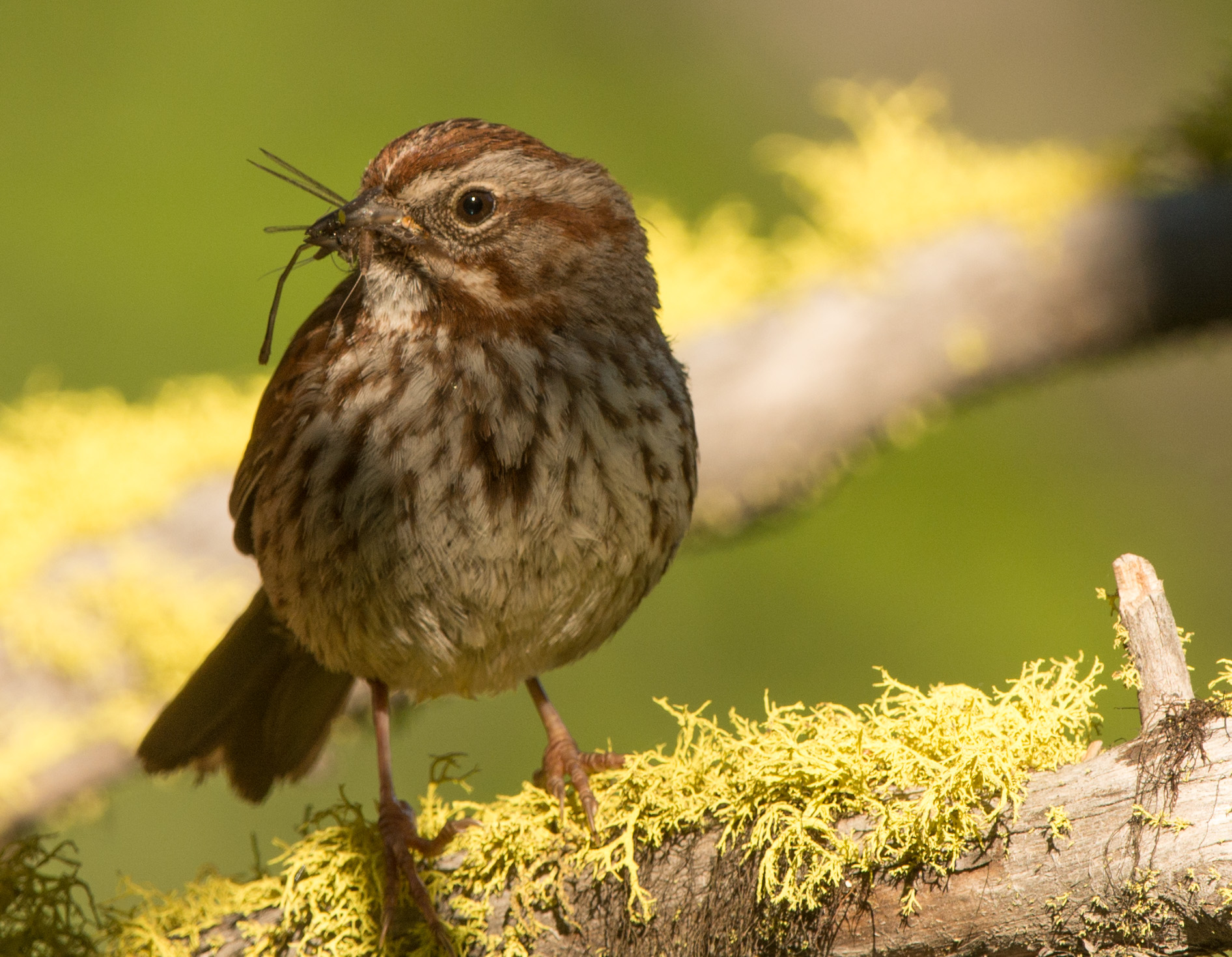
It’s unusual to have a Song sparrow in the watercourse.  We had only a single Song sparrow all this past winter.  But this one was apparently inspired by a male Red Crossbill that was visiting the watercourse.

Sparrow, Song 20150317-02


The male Anna’s hummingbird(s) that overwintered with us have used the watercourse for bathing from time to time.  I measured the temperature this past week at 55-degrees… MUCH too cold for me!

Hummingbird, Anna's 20150317-03

And as I’ve recorded in prior blog posts, the Rufous hummingbirds have arrived and are making use of the watercourse for bathing.  Pictured below is a male which, after about a two-week truce, has now begun trying to defend feeders.  I expect things to quickly get worse.

Hummingbird, Rufous 20150317-03 Hummingbird, Rufous 20150317-01

And finally, one of our regular visitors at the beginning of the winter season is now returning on occasion.  We’ve missed the pair of Golden-crowned kinglets, but I think it was another species scared away by our accipiter.

I find this photo rather interesting.  The bird has a very bright orange crown located in the middle of the yellow area, but it’s not visible even though the bird is showing the top of its head.  (If you look VERY closely you can see a very slight tinge of orange within the yellow.)  In the third photo below you can clearly see how visible the orange crown can be.  What’s interesting is that the bird can so effectively hide/display it.

Kinglet, Golden-crowned 20150317-03 Kinglet, Golden-crowned 20150317-01


Kinglet, Golden-crowned 20150317-05

Friday the 13th (of March, 2015) developed into a good day for bird watching and photographing.  I spent significant time in the yard (with the aforementioned Pine siskins).  As I saw I became aware of a subtle song, the issuer of which seemed to be approaching the yard.  I had a difficult time picking the bird out of all the other bird activity, but finally managed to isolate a male Yellow-rumped warbler of the Audubon race… in almost full breeding plumage!  This was my first warbler (in the yard) for the year!  The bird traveled from a small madrone tree to the watercourse and I managed probably about 20 photographs of the bird.  Yellow-rumped warblers can be found here year-round, but in the winter they are here in much smaller numbers and are not in breeding plumage.  This bird approached the watercourse but never entered it, and after about five minutes in the yard left.

Warbler, Yellow-rumped - Audubon 20150313-07 Warbler, Yellow-rumped - Audubon 20150313-10 Warbler, Yellow-rumped - Audubon 20150313-13

This same day I had several other welcome visitors.  Here are a couple of Red crossbills accessing a hanging water feature, but the birds don’t seem to have a preference among hanging features, static ground features or moving water features.  The bird at the back of the water feature is a Pine siskin.   

Crossbill, Red 20150313-07
These are close-up photos of a male Red crossbill in the watercourse.
Crossbill, Red 20150313-09


Crossbill, Red 20150313-01next bird is always a welcome visitor in that it gives me more opportunities to obtain photos of a bird that I find very difficult to photograph… the Brown creeper.  This creeper always works its way UP a tree, only pausing its frenetic activity if it manages to find a good-sized bug wedged in the cracks in the bark.  (Note the long, curved bill for performing the extractions.)

Creeper, Brown 20150313-07 Creeper, Brown 20150313-02

And finally, a couple of other species that are finally returning to the yard.  We have a pair of Northern flickers...

Flicker, Northern 20150313-04

and also a pair of Downy woodpeckers (this one the male).

Woodpecker, Downy 20150313-01


Spring Yard Birds

The bird that started my spring yard activities was a late afternoon, March 12, (2015) sighting of a male Varied thrush in the yard…

Thrush, Varied 20150312-02

I was very excited when this bird showed up and migrated to our watercourse.  My wife alerted me to the bird and after verifying that it was still in the watercourse I tried to sneak out the front door, which in the last month has developed a squeaky hinge!  The thrushes can be quite in tune with human activity.  We had two frequent the construction site daily during the building of our house in the winter of 2007, but I can tell you that the birds don’t like being sneaked up on!  I managed about three photos of this bird before it left the yard and to my knowledge it hasn’t been back since.  I’ve seen and heard one or two birds in Washington Park on my walks but expect that what few we seem to have in the lowlands will be returning to their mountain retreat before long.

The Varied thrushes are beautiful birds.  We usually have at least a few around the yard in the winter, but this past winter we initially had two and then they quickly disappeared.  My theory is that they have been gone due to the accipiter that we had around for at least a couple of months as well as the fact that we have had a relatively mild winter and the cold and snow haven’t been enough to drive the birds down from the mountains.

Another species of bird that has been largely absent this past winter has been the Red crossbill.  During this same period they have begun returning to the watercourse, and on several occasions I’ve been able to see a group of up to three females and two males access one of the water features at one time.  This is a female in the watercourse…

Crossbill, Red 20150312-02

A species that has been conspicuously absent is the House finch.  We usually have a plentiful supply of them at all times of the year, but they have been absent for the last couple of months until just recently.  I attribute their absence to the accipiter.

Finch, House 20150312-03


Pine Siskins

Siskin, Pine 20150317-02

By mid-March we began having some spring-like weather.  There hadn’t been many unusual species of birds in the yard but with the better weather I began to spend more time in the yard.  We were over-run with Dark-eyed juncos and Pine siskins but relatively few other species.

On one of my first days I spent in the yard we had Pine siskins flying everywhere.  I surmised, it turns out correctly, that they would probably attract some other species.  I’ll deal with those in a subsequent blog post.  But as I sat in the yard the siskins were flying back and forth all around me.  On two occasions the siskins almost lit on my head.  After a while I had one light on the end of my lens as I had my face near my camera!  About three minutes later one lit on the camera itself.  My face was up against the back of the camera and my first thought was that the bird might peck me in the eye (it was probably less than two inches away), but then I realized that I was wearing the new eyeglasses that I had obtained less than two months previously.  After a few seconds the Pine siskin flew, but a while later another one landed on the end of my lens.  What I wouldn’t have given for a photograph!

The Pine siskins are extremely gregarious but also extremely aggressive among not only other species, but also their own.  They seem to enjoy being together, but if they get too close to one another it almost always evokes an aggressive response.  Pictured below is the bird’s warning posture… it leans forward, opens its beak and occasionally spreads its wings.  In this case this bird was bathing and it’s warning another bird on a rock above it not to come so close!

Siskin, Pine 20150317-06

Here are a couple of more photos of siskins.  I’m guessing that this one is probably a male due to the bright colors on the bird.

Siskin, Pine 20150317-13

This bird is probably either a female or a first-year juvenile.  Note the formidable sharp beak the bird has.

Siskin, Pine 20150317-09

In my next post I’ll show some of the birds attracted by the spring weather and the presence of all the other birds in the yard.