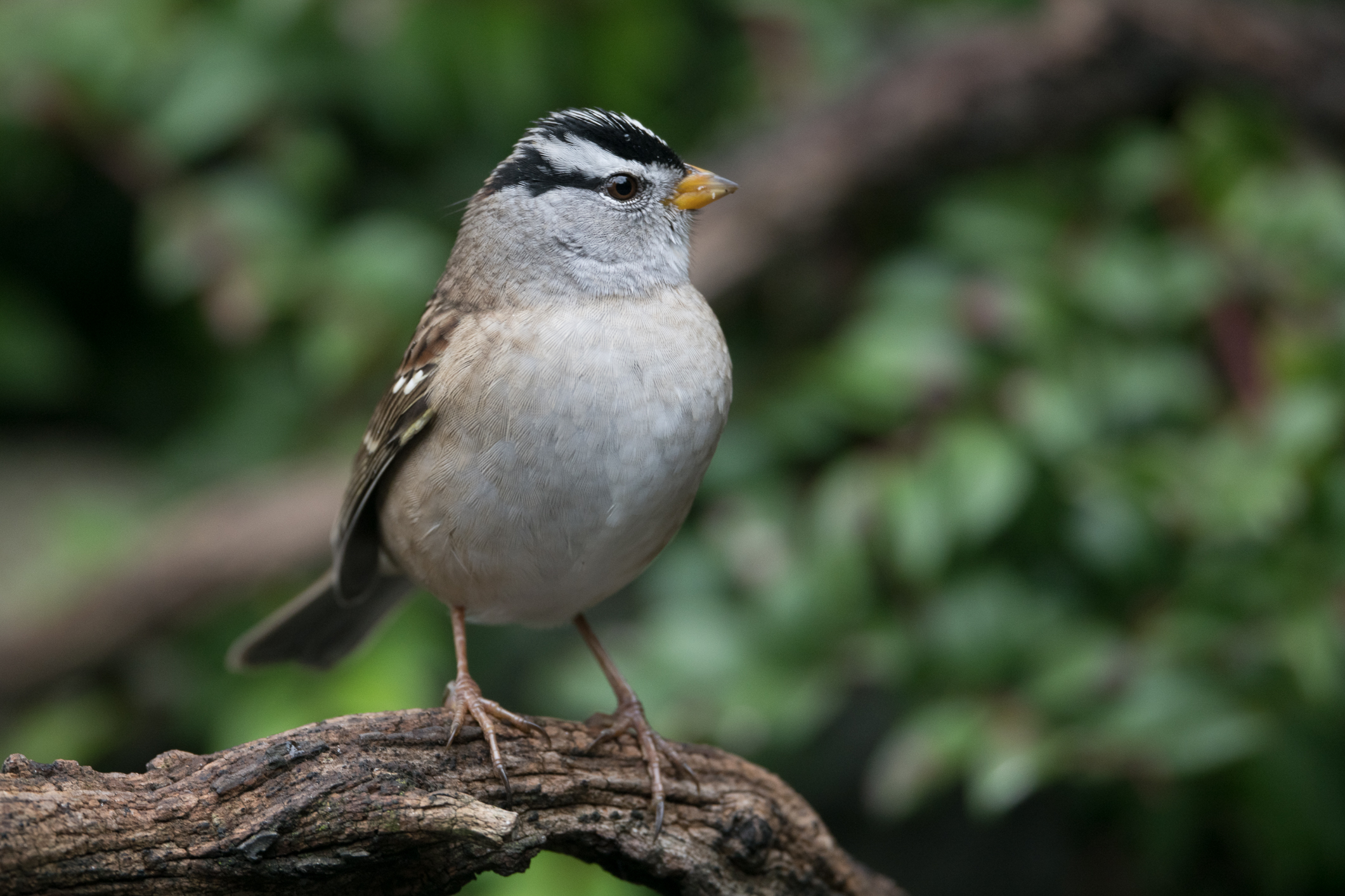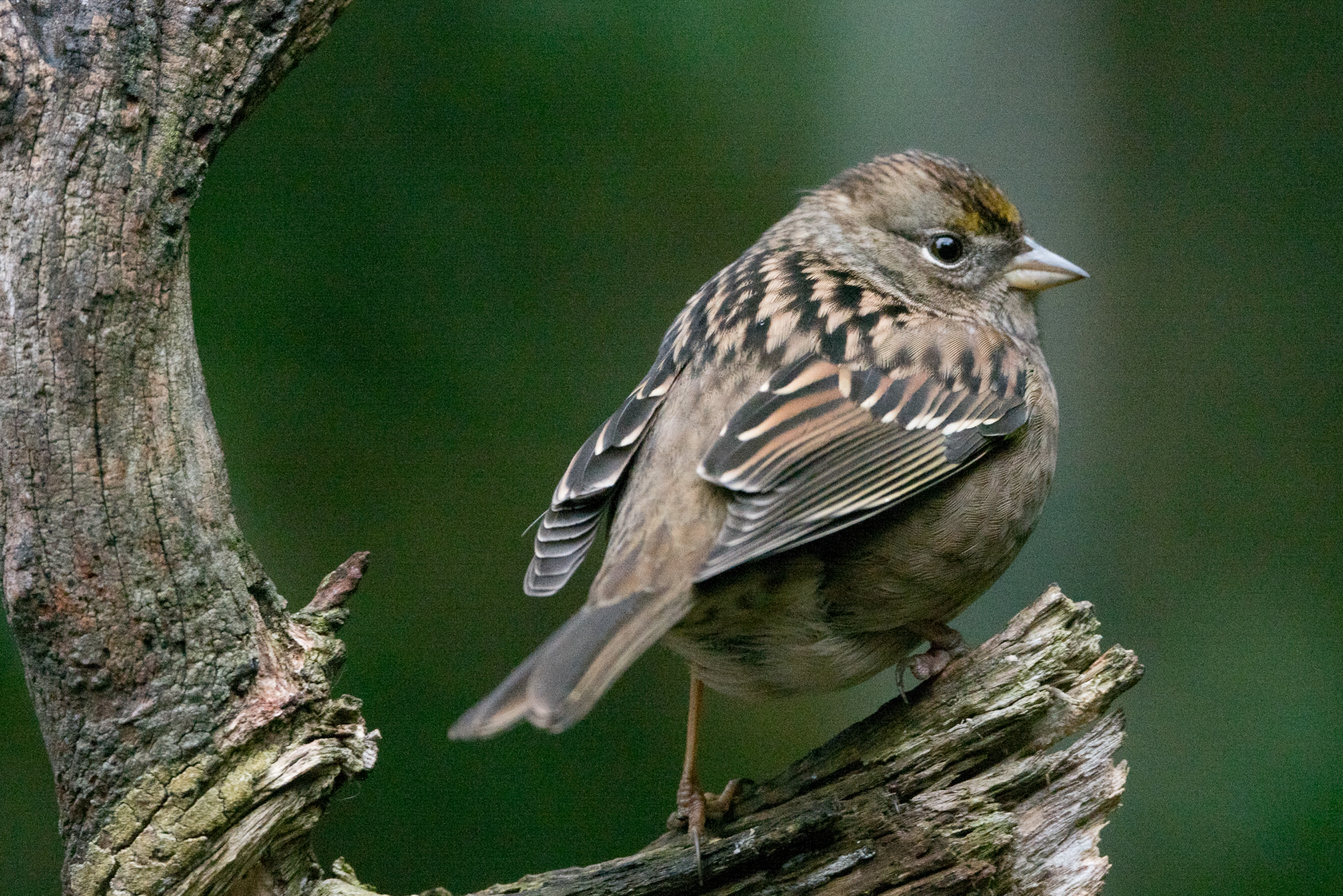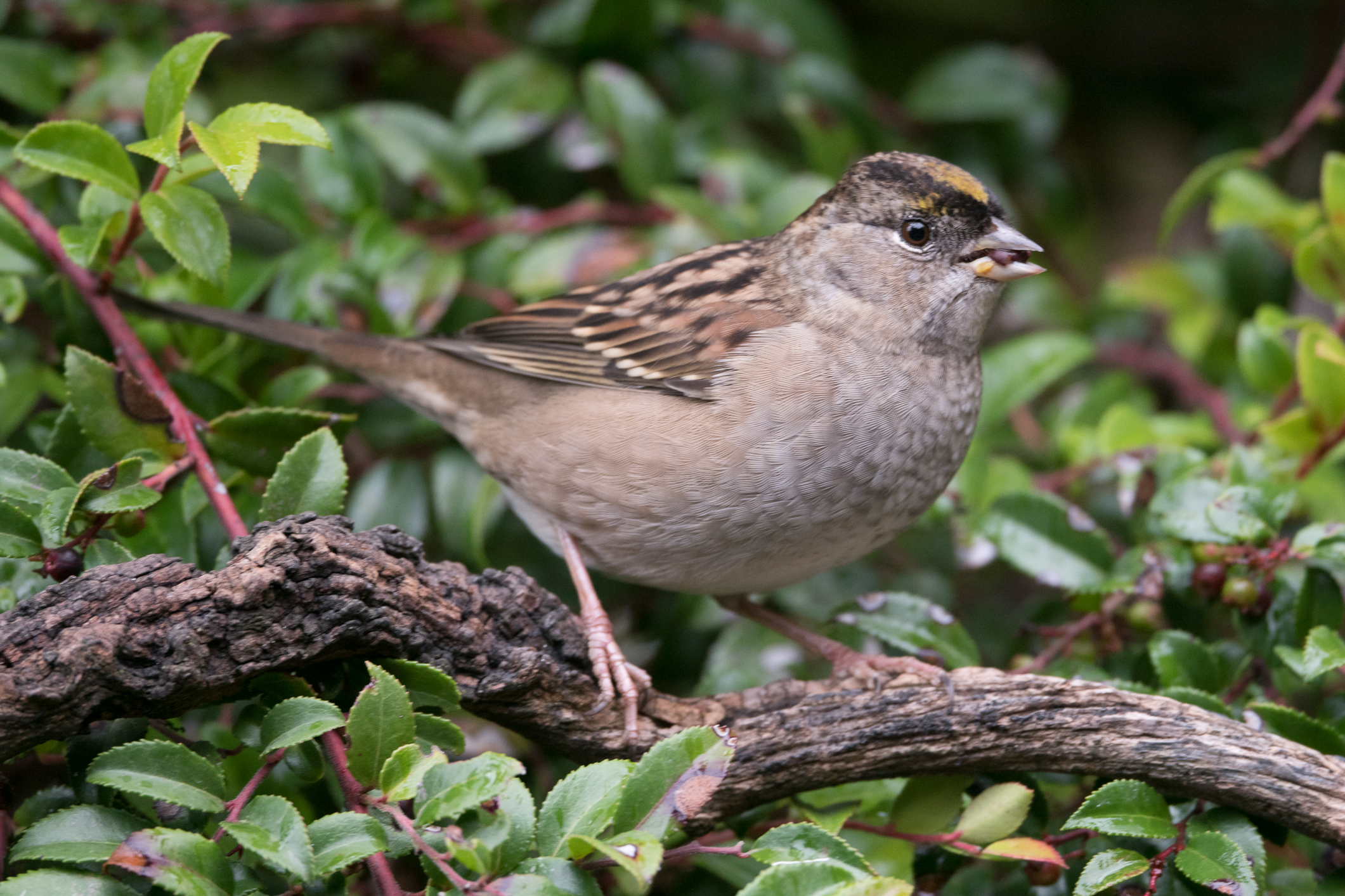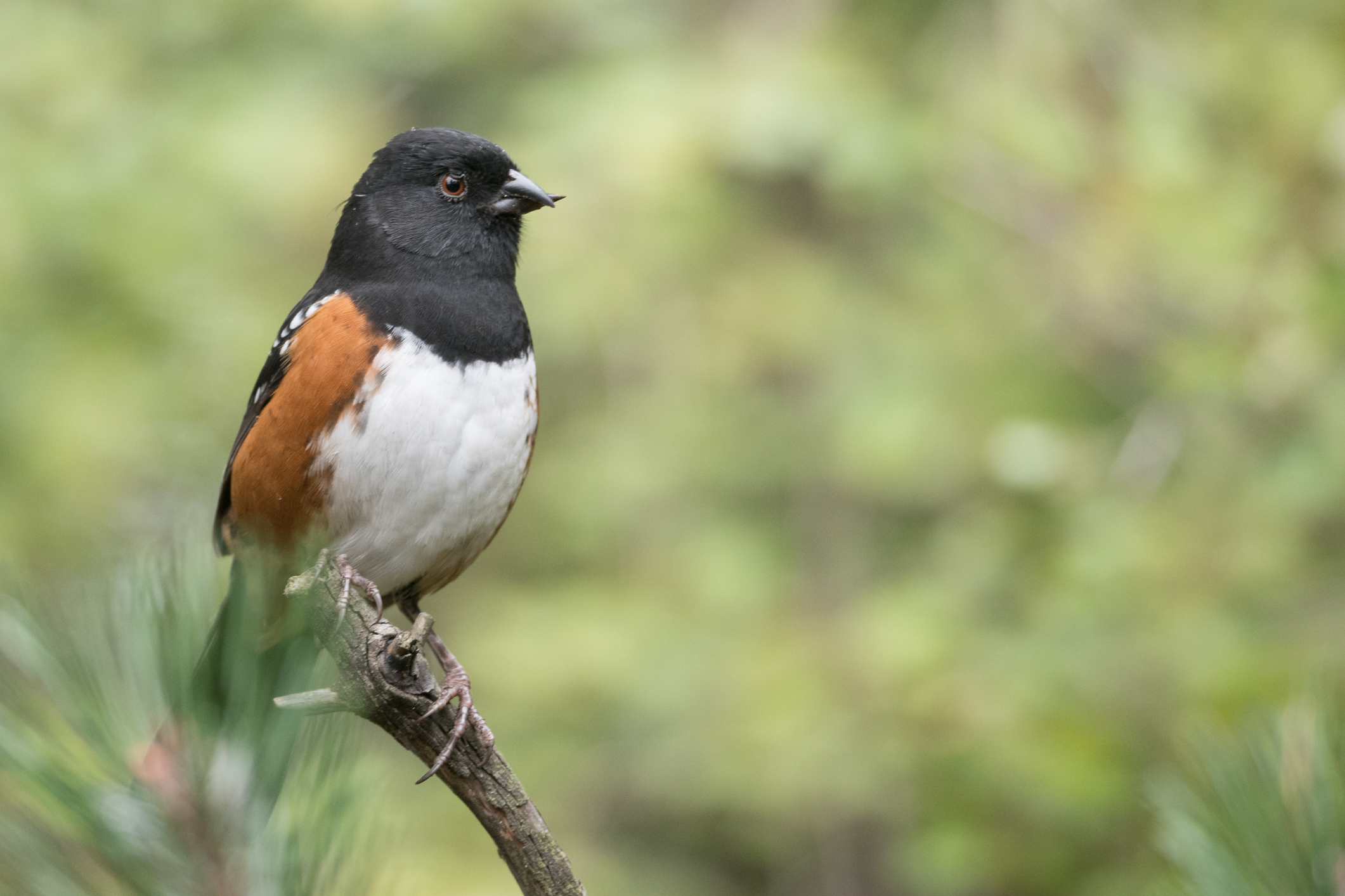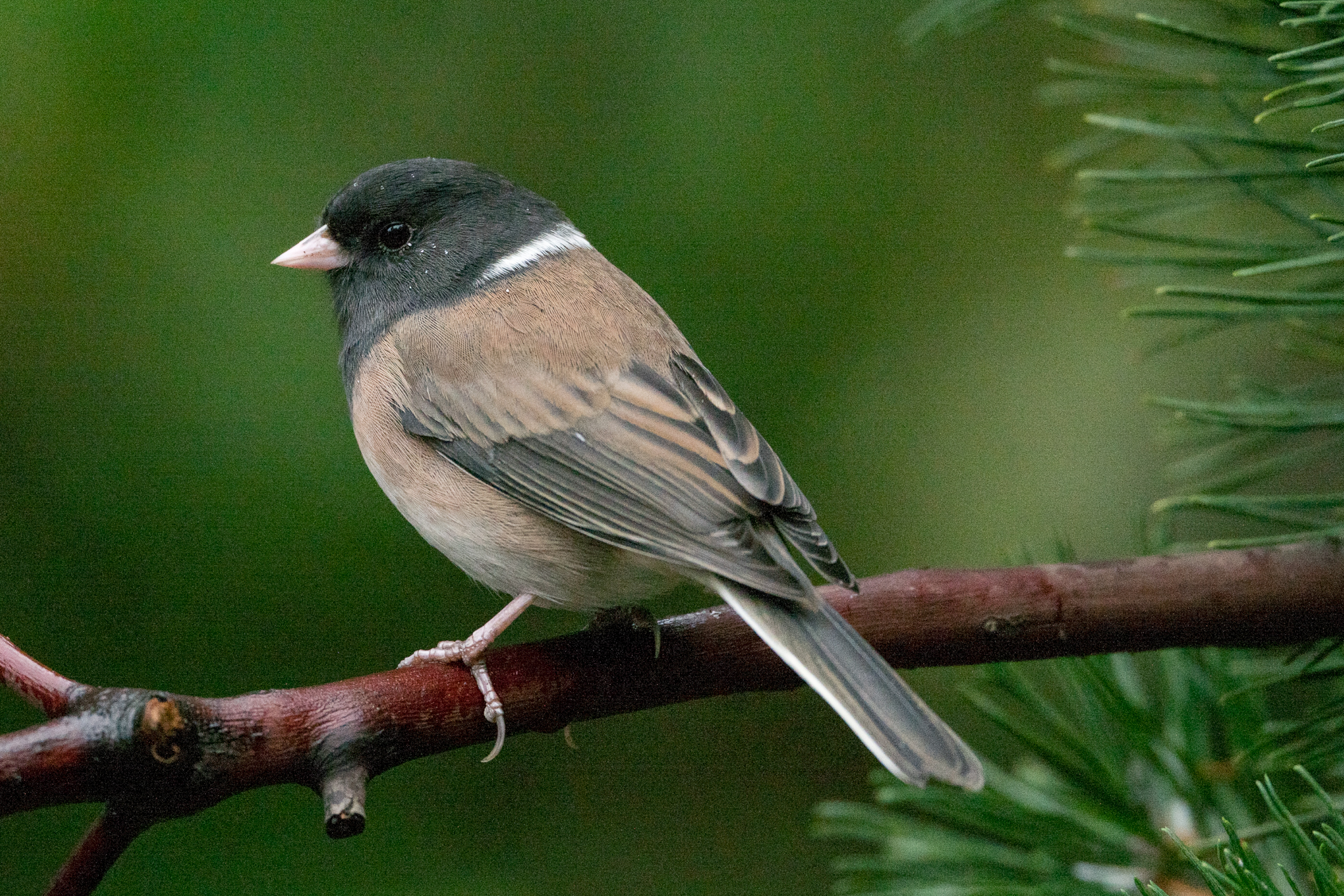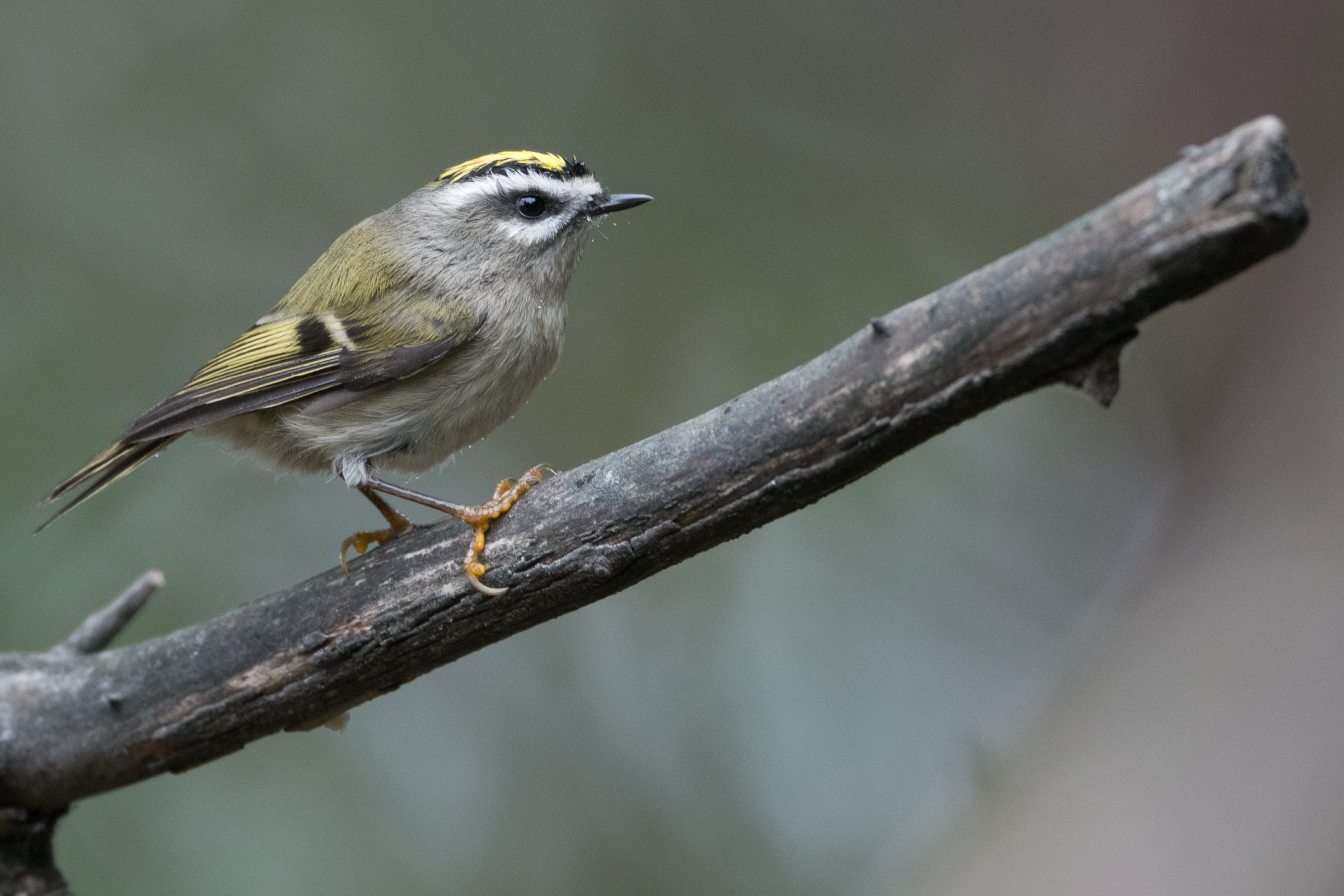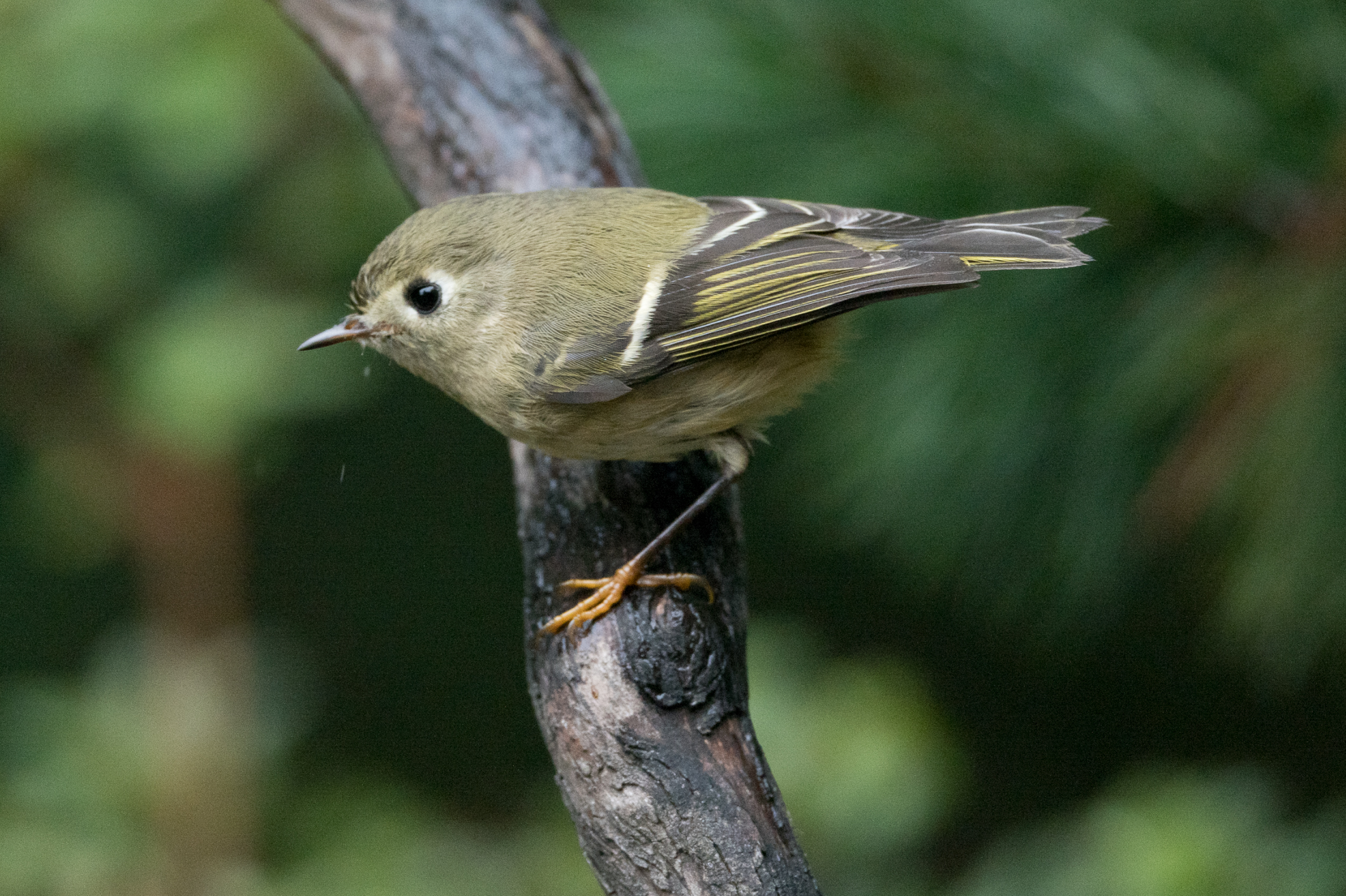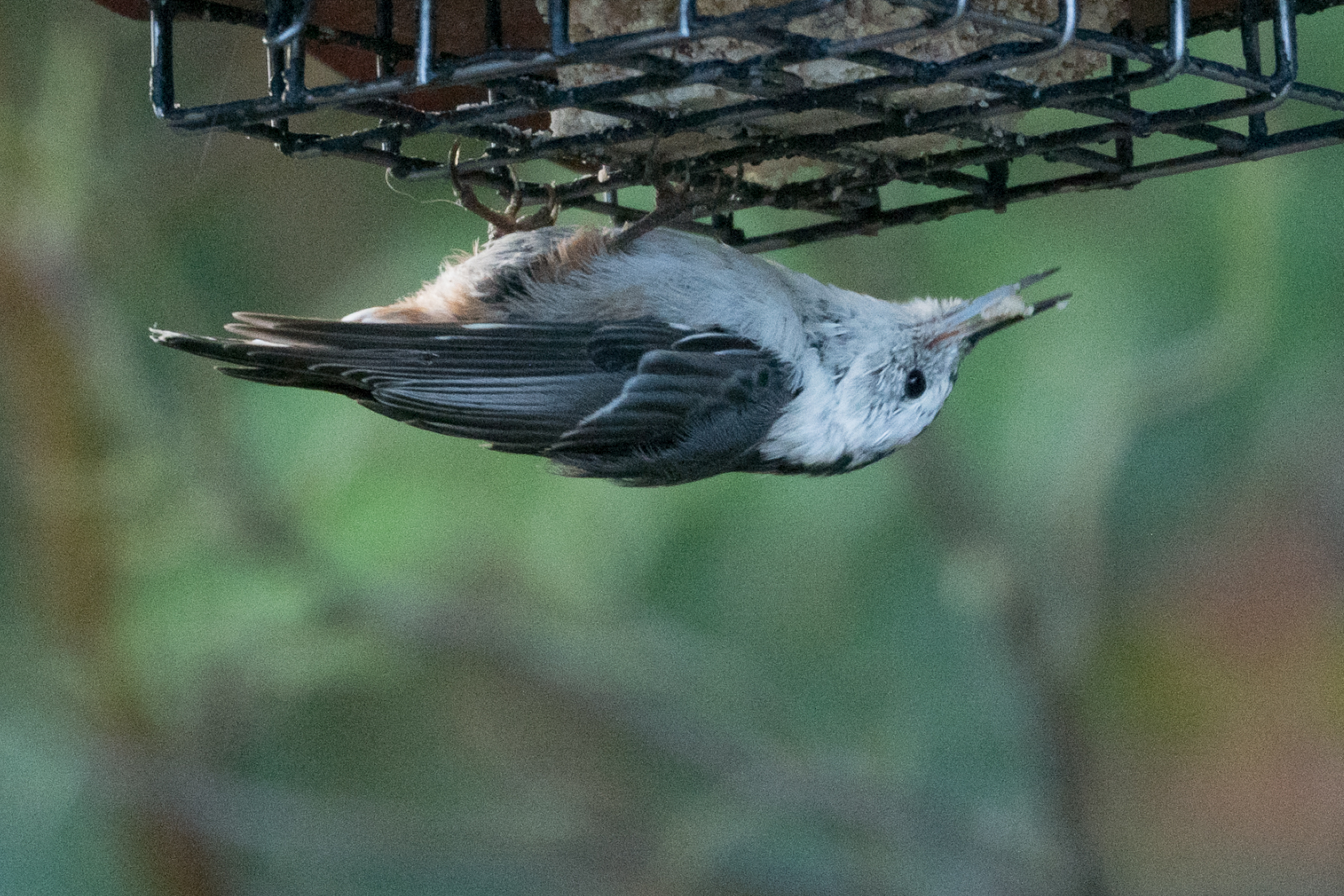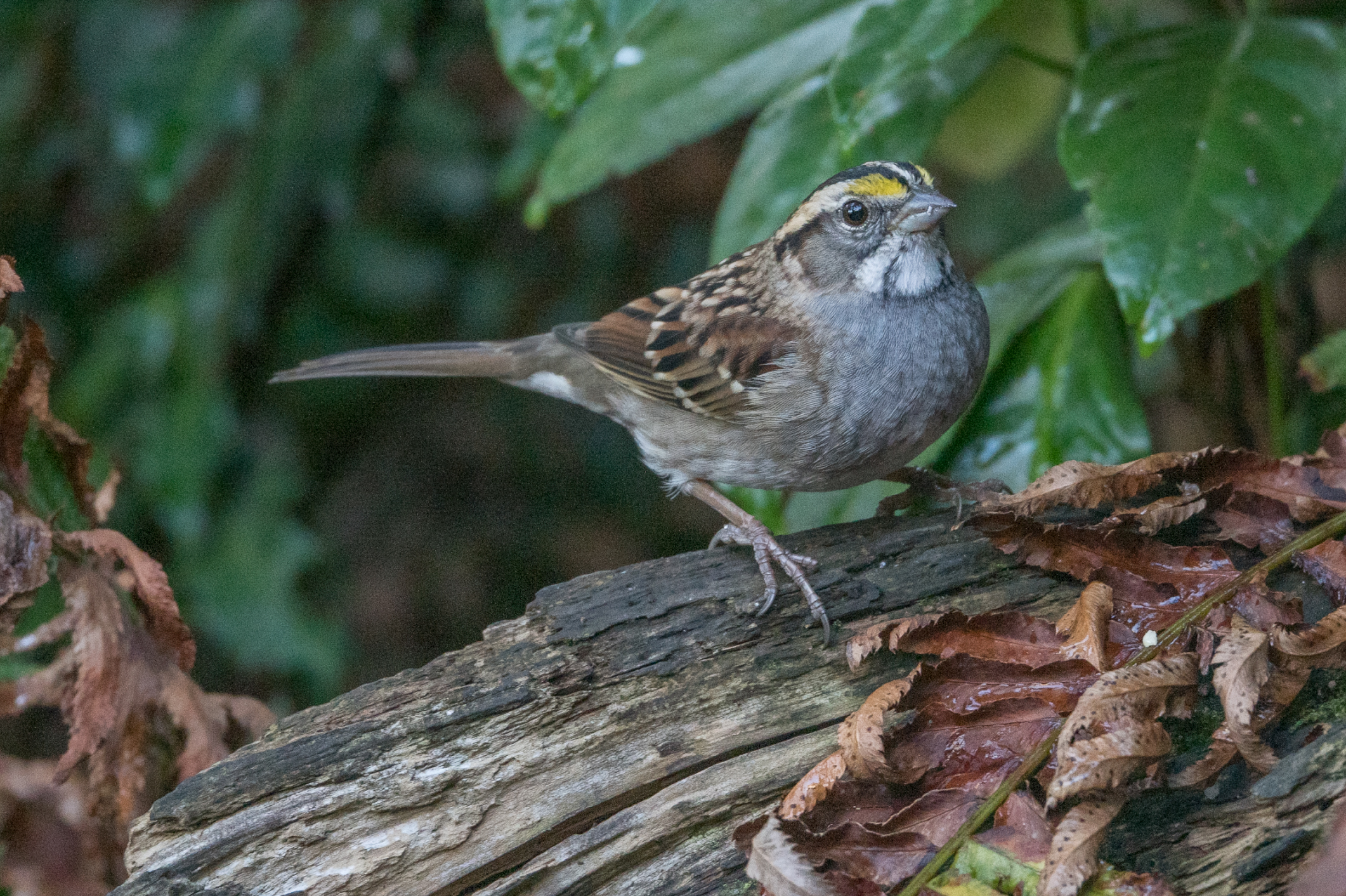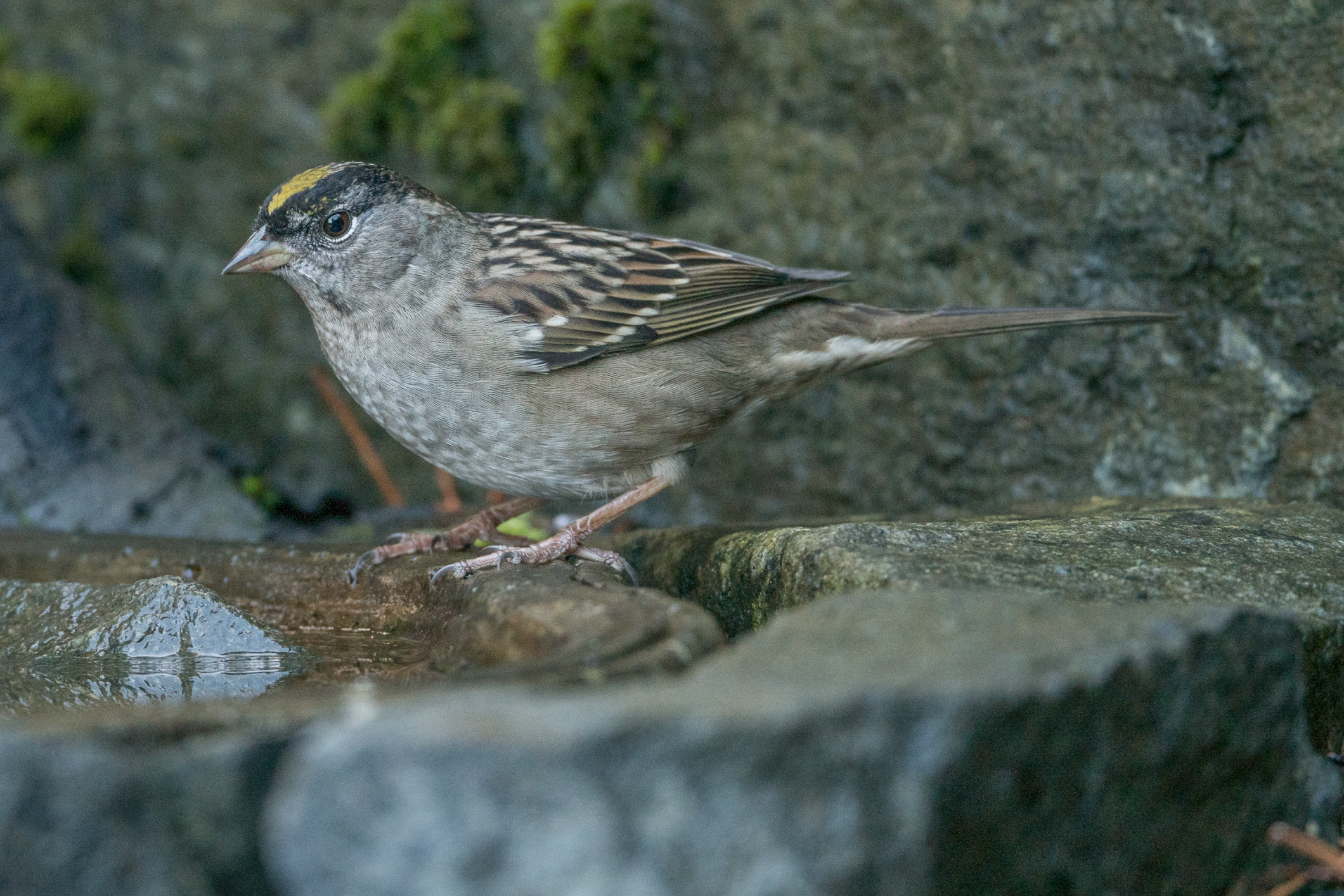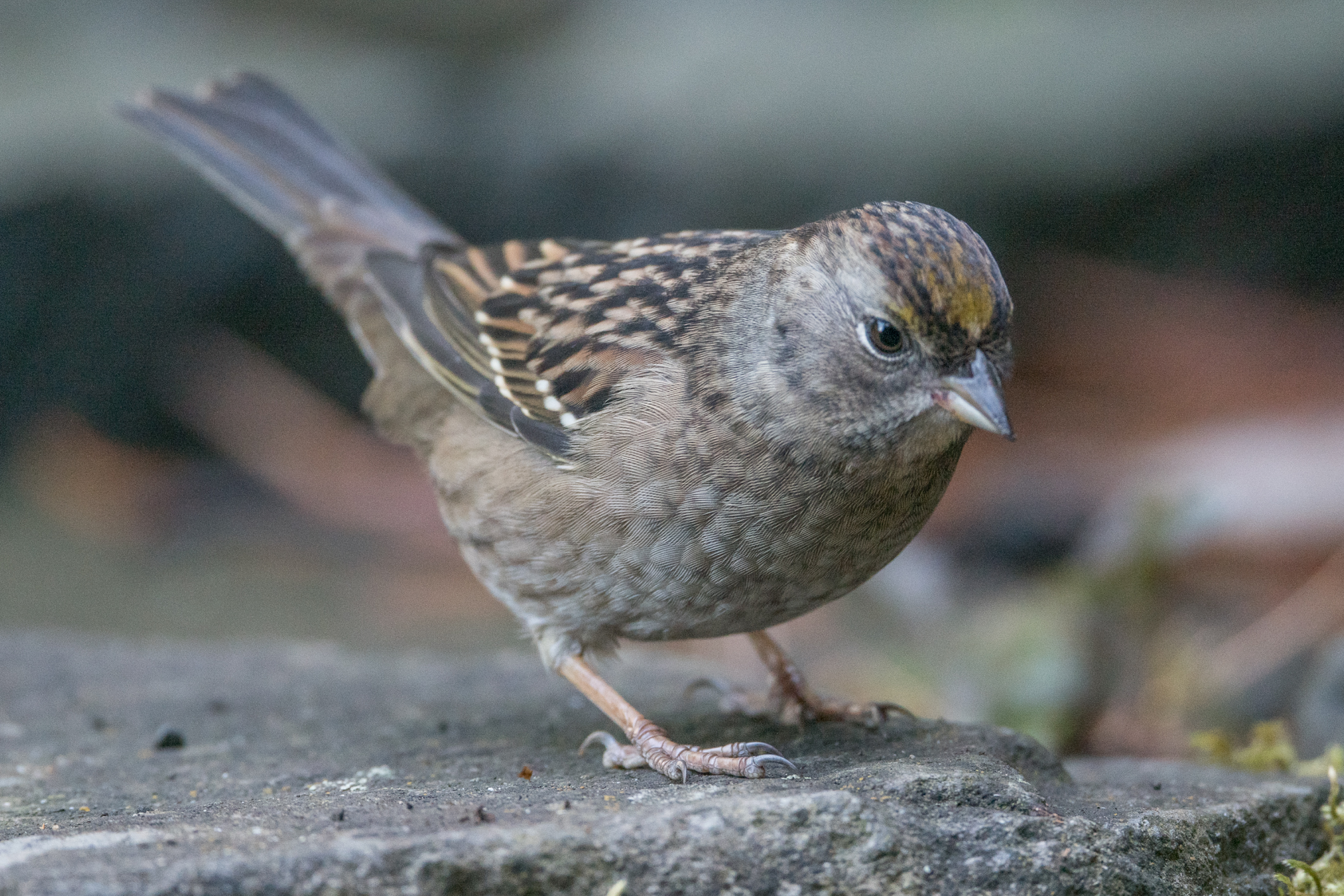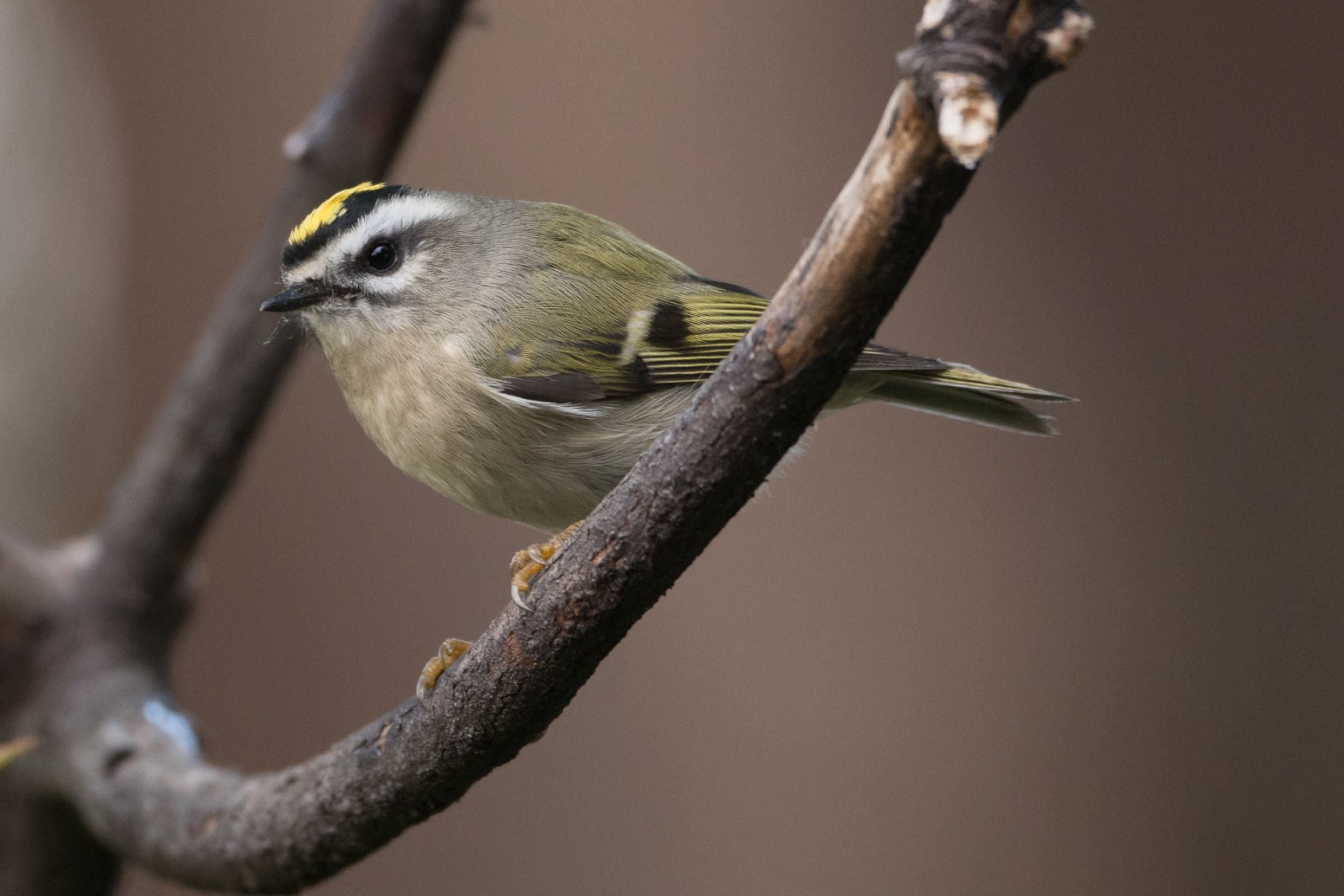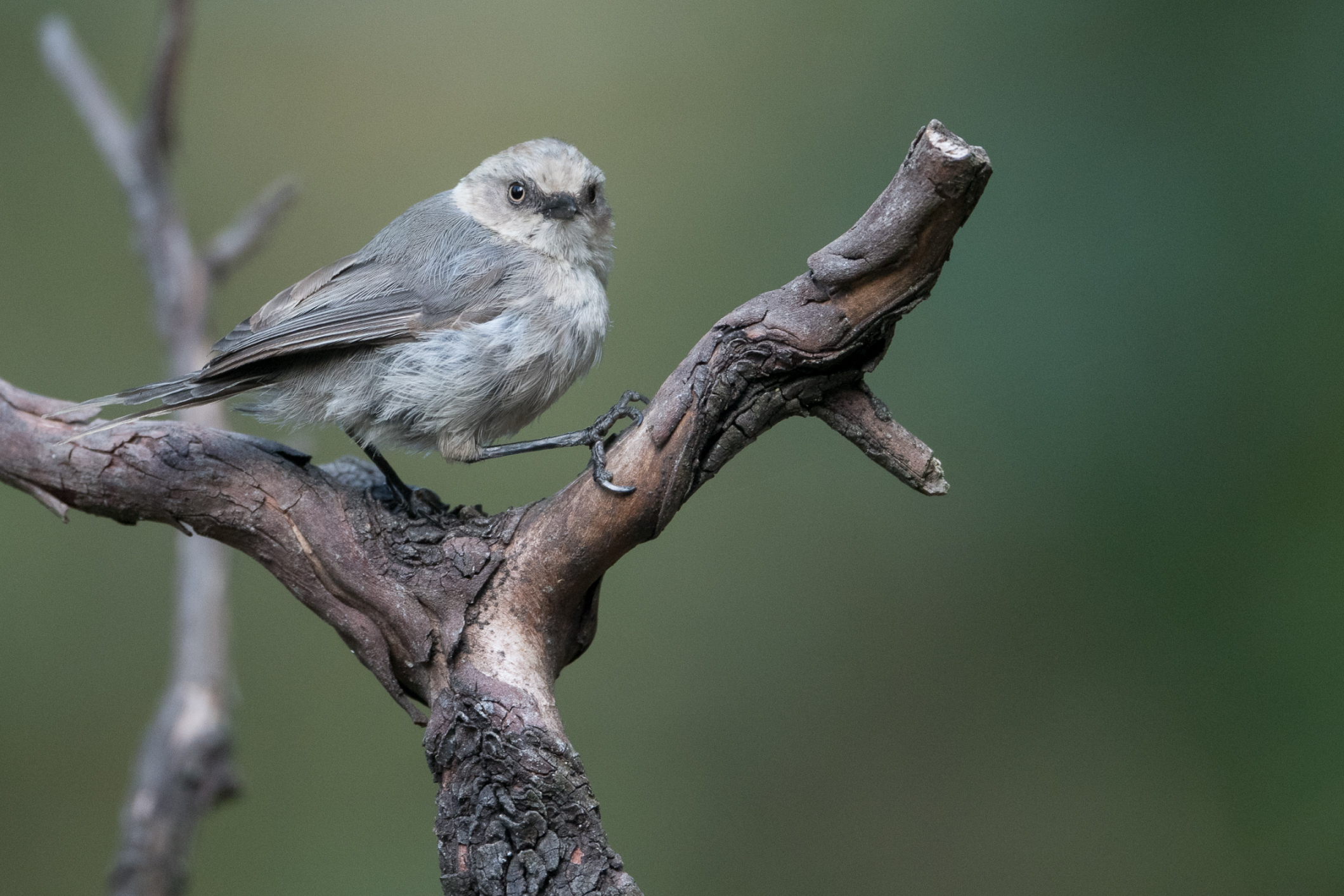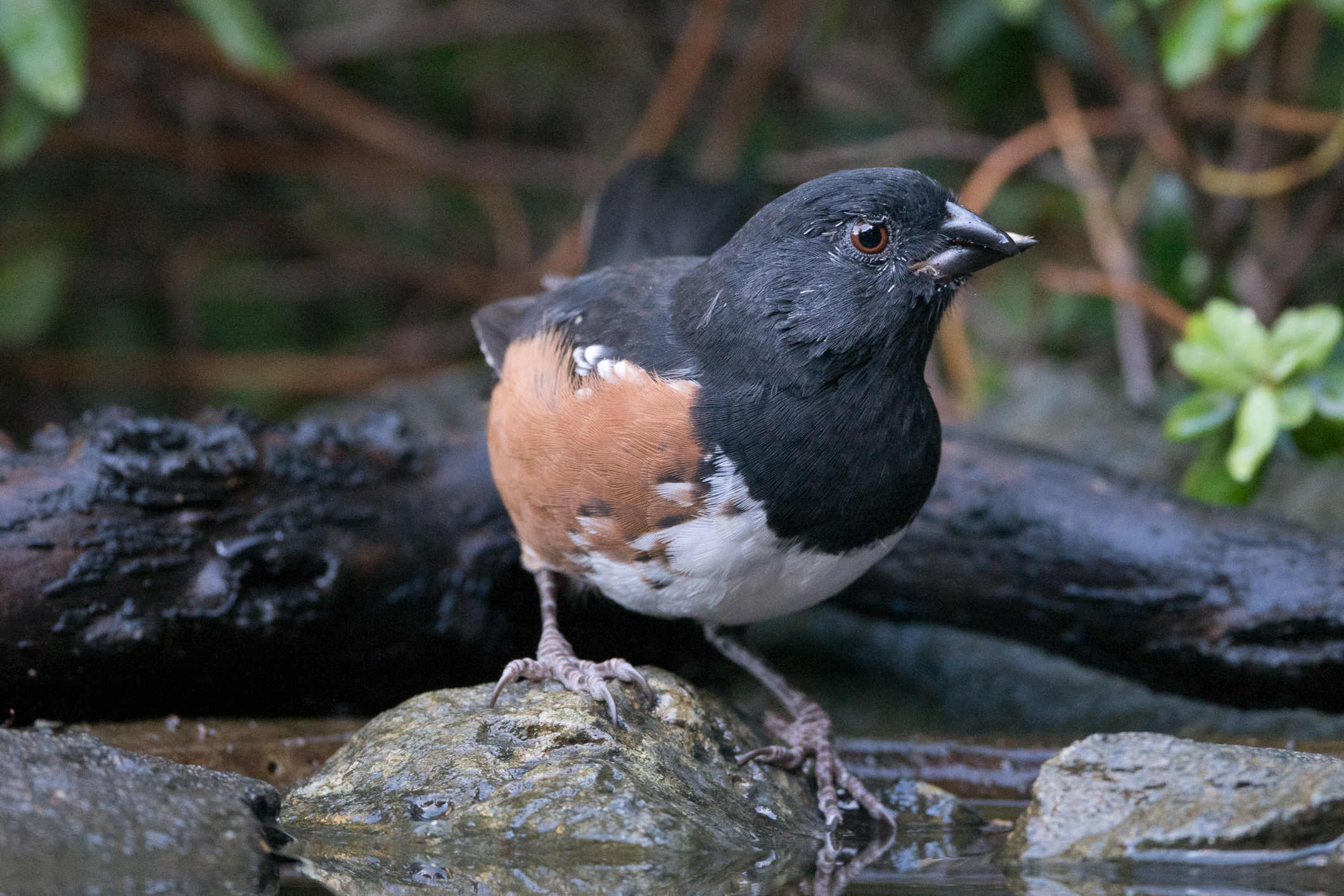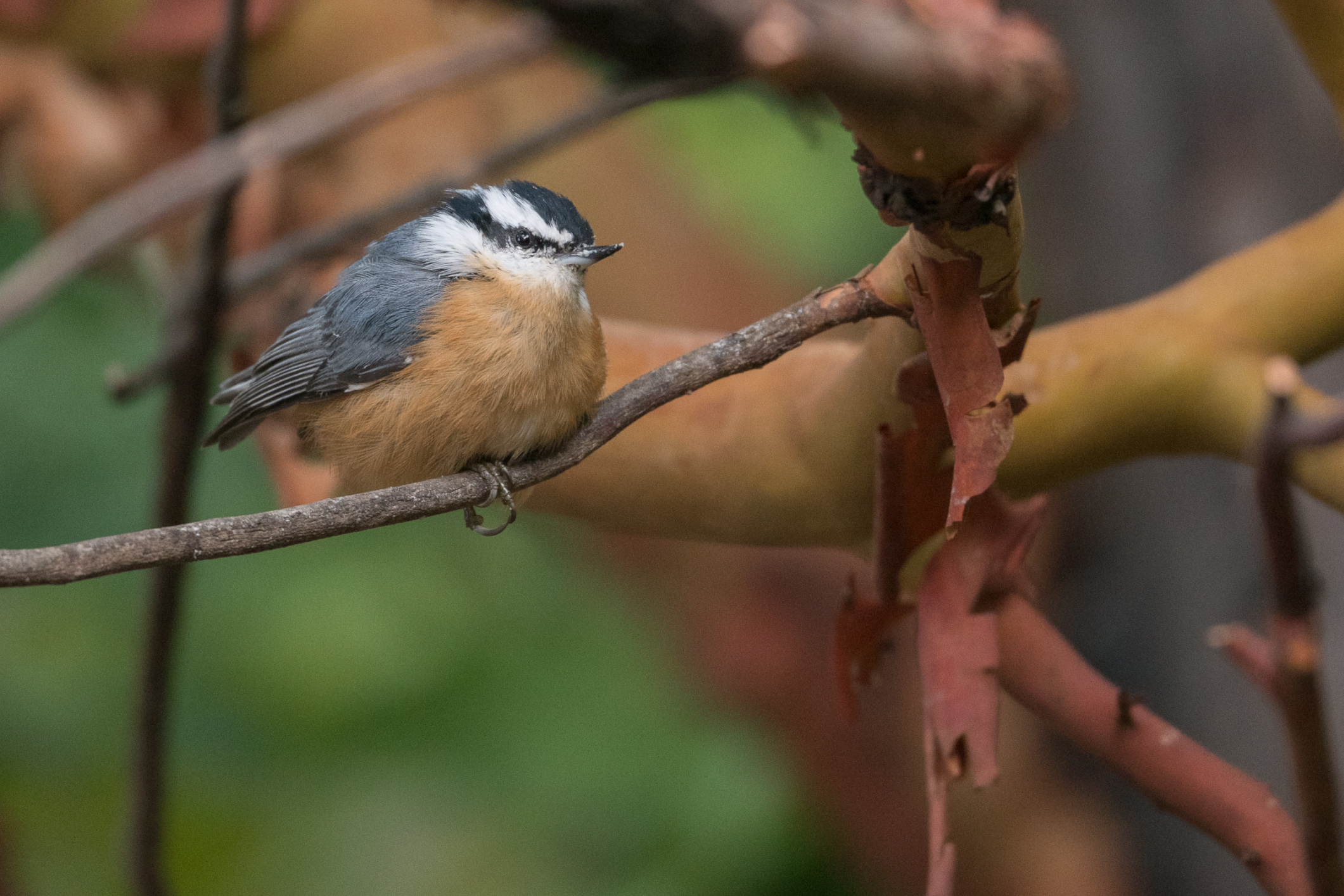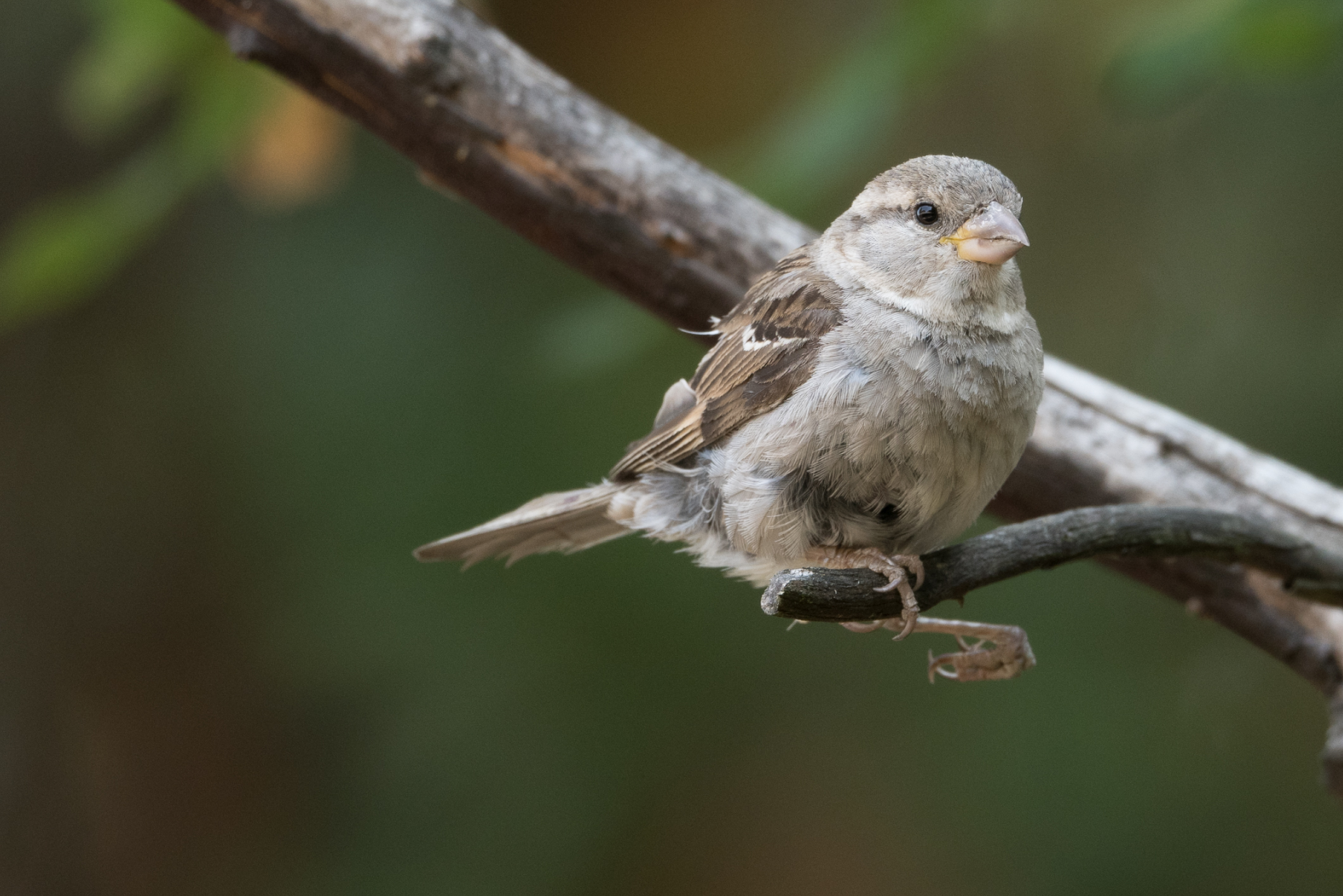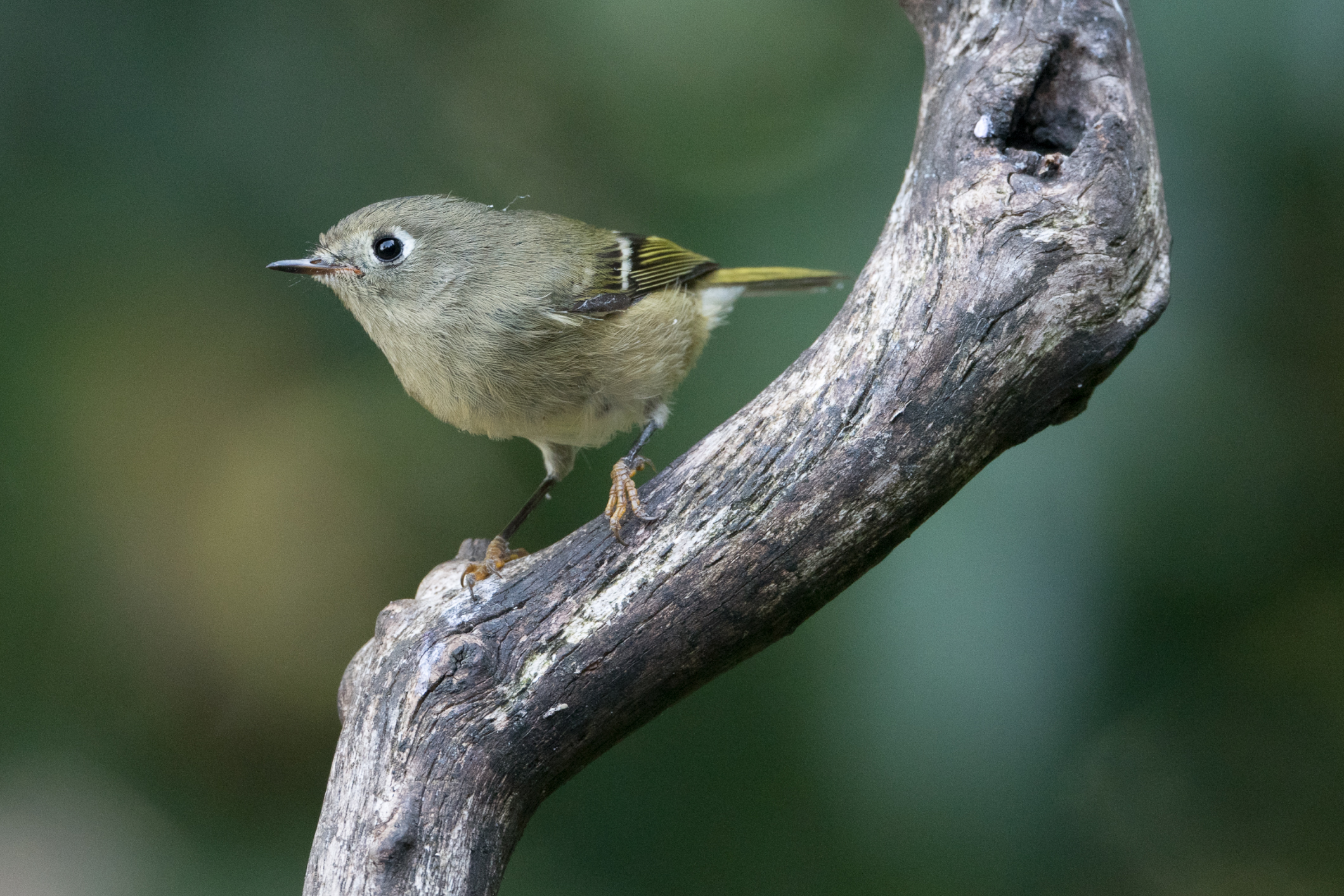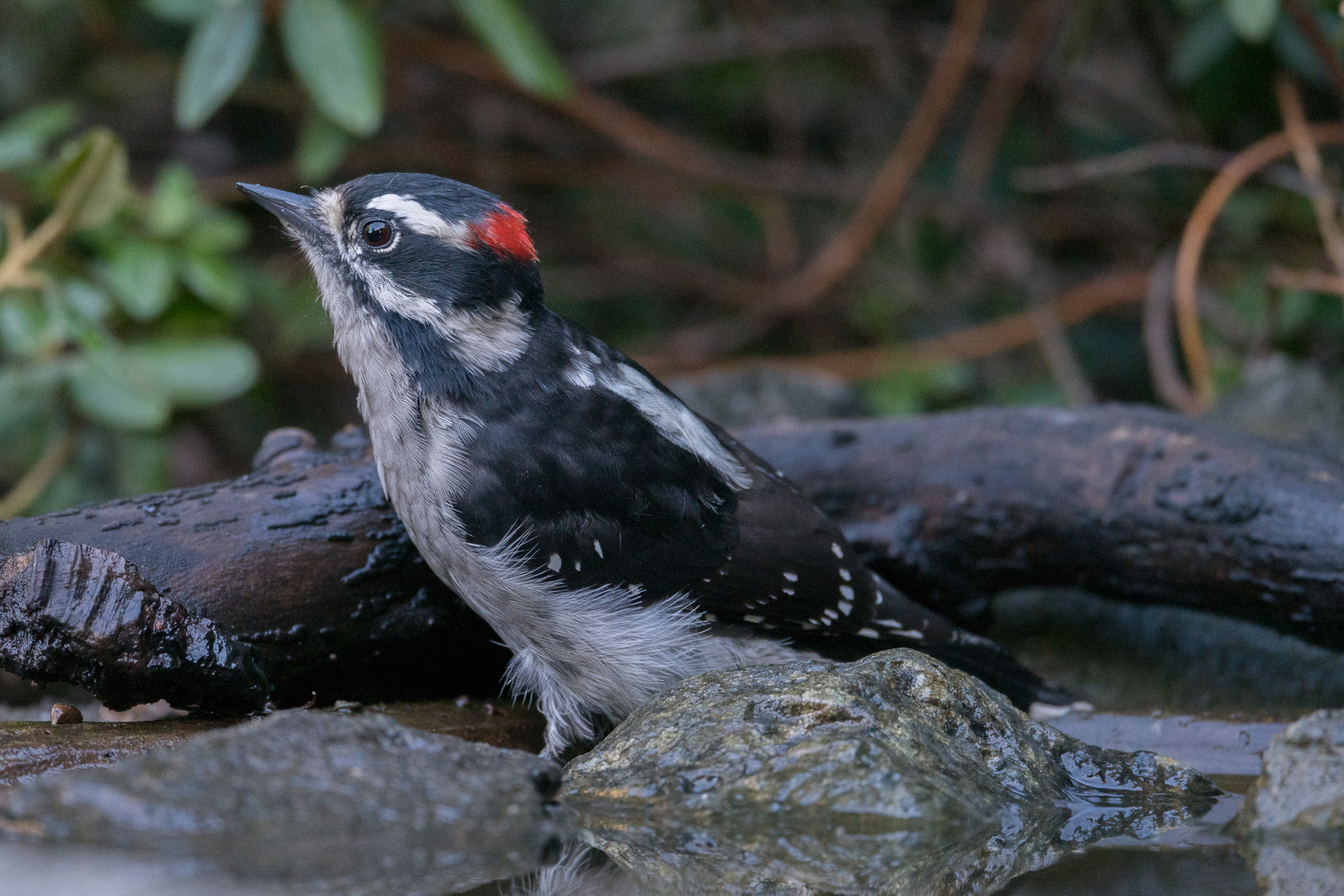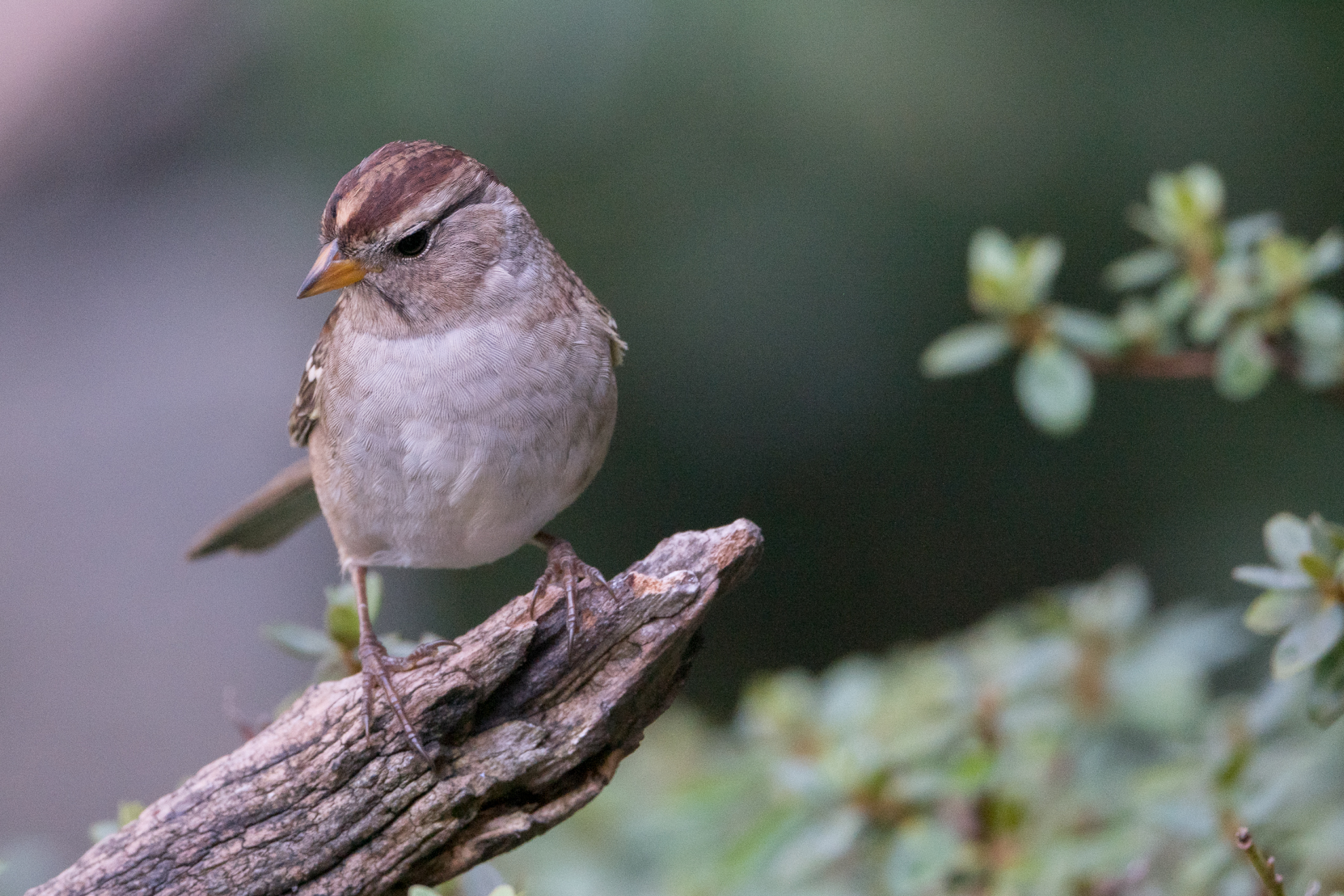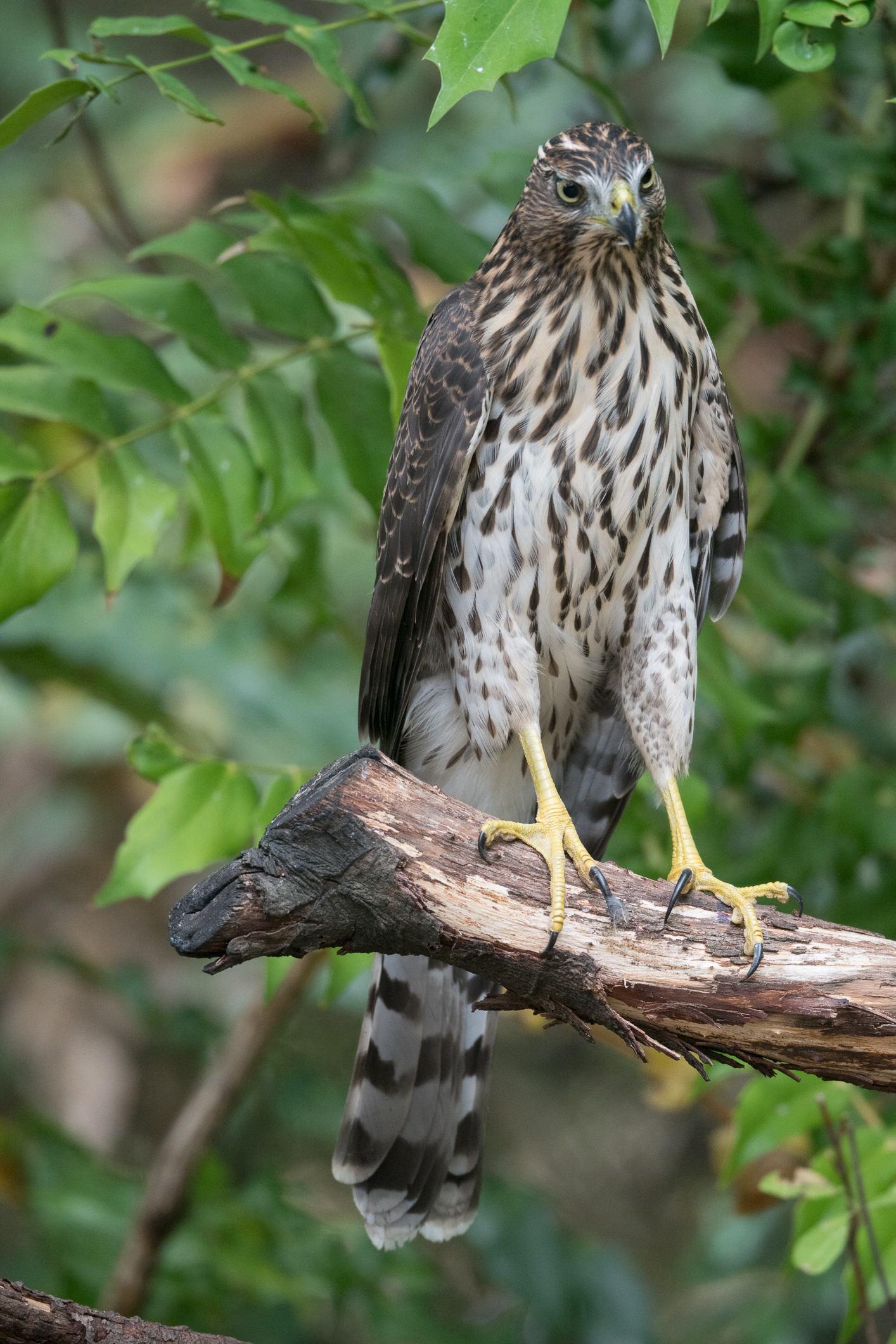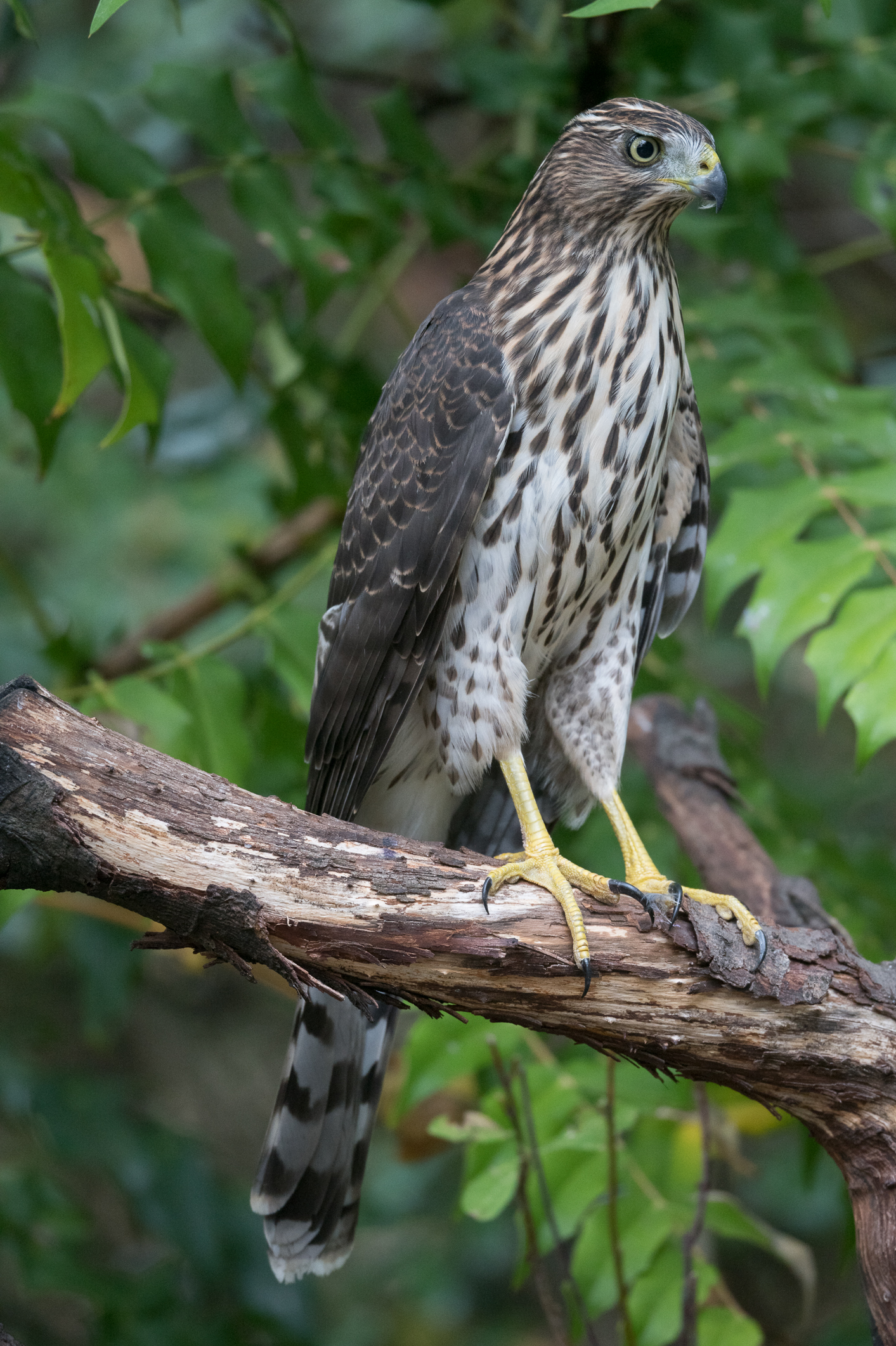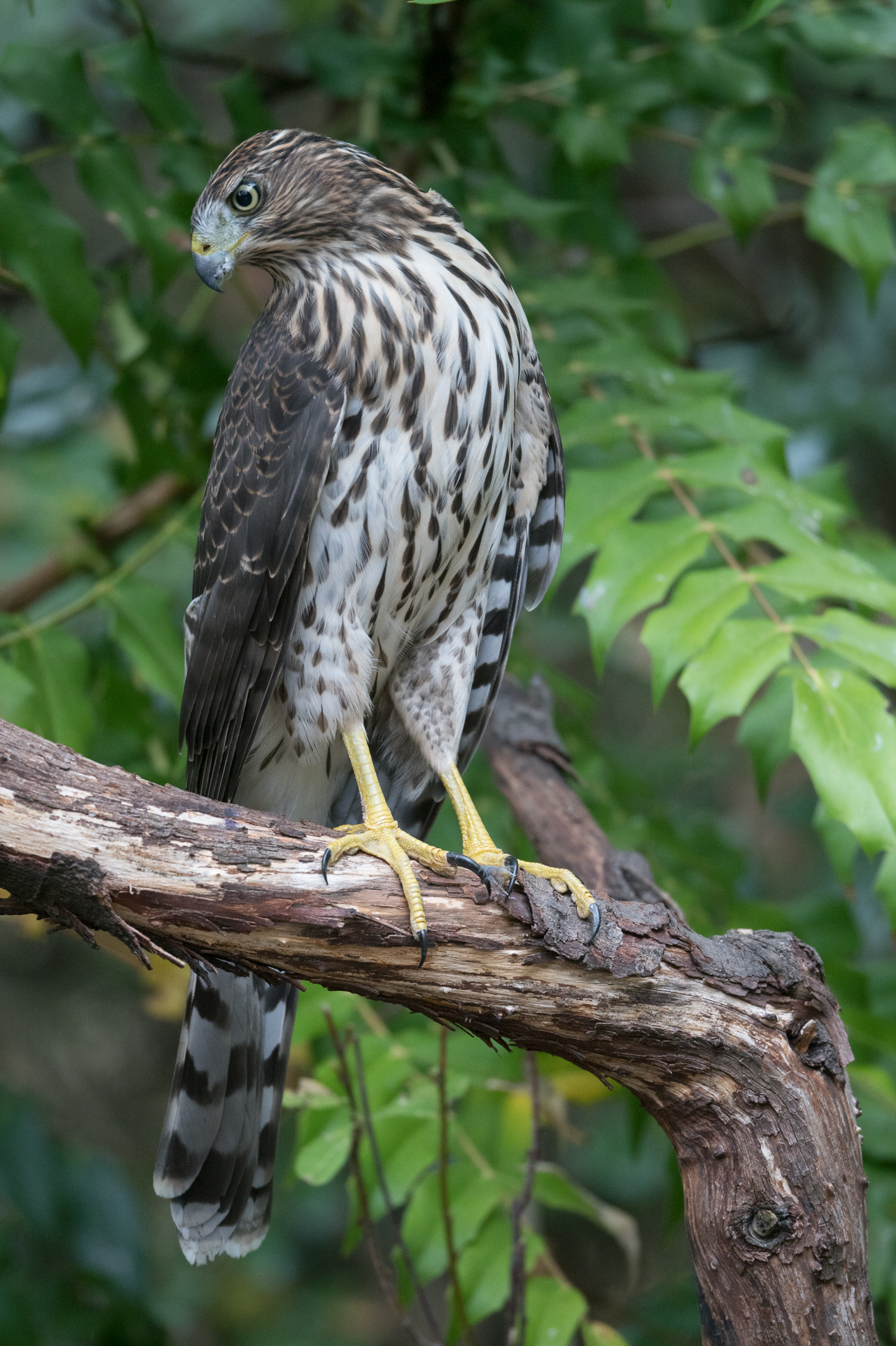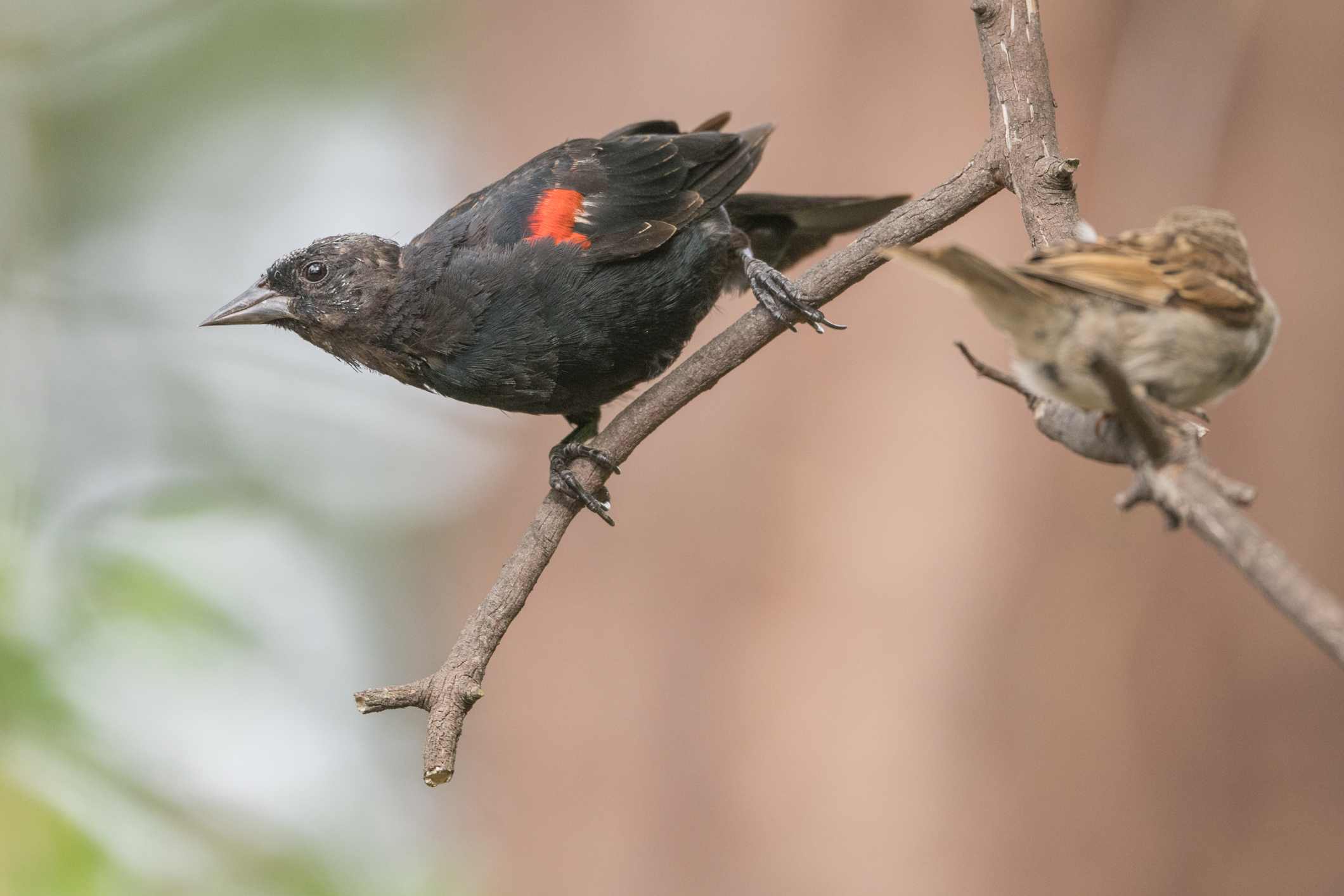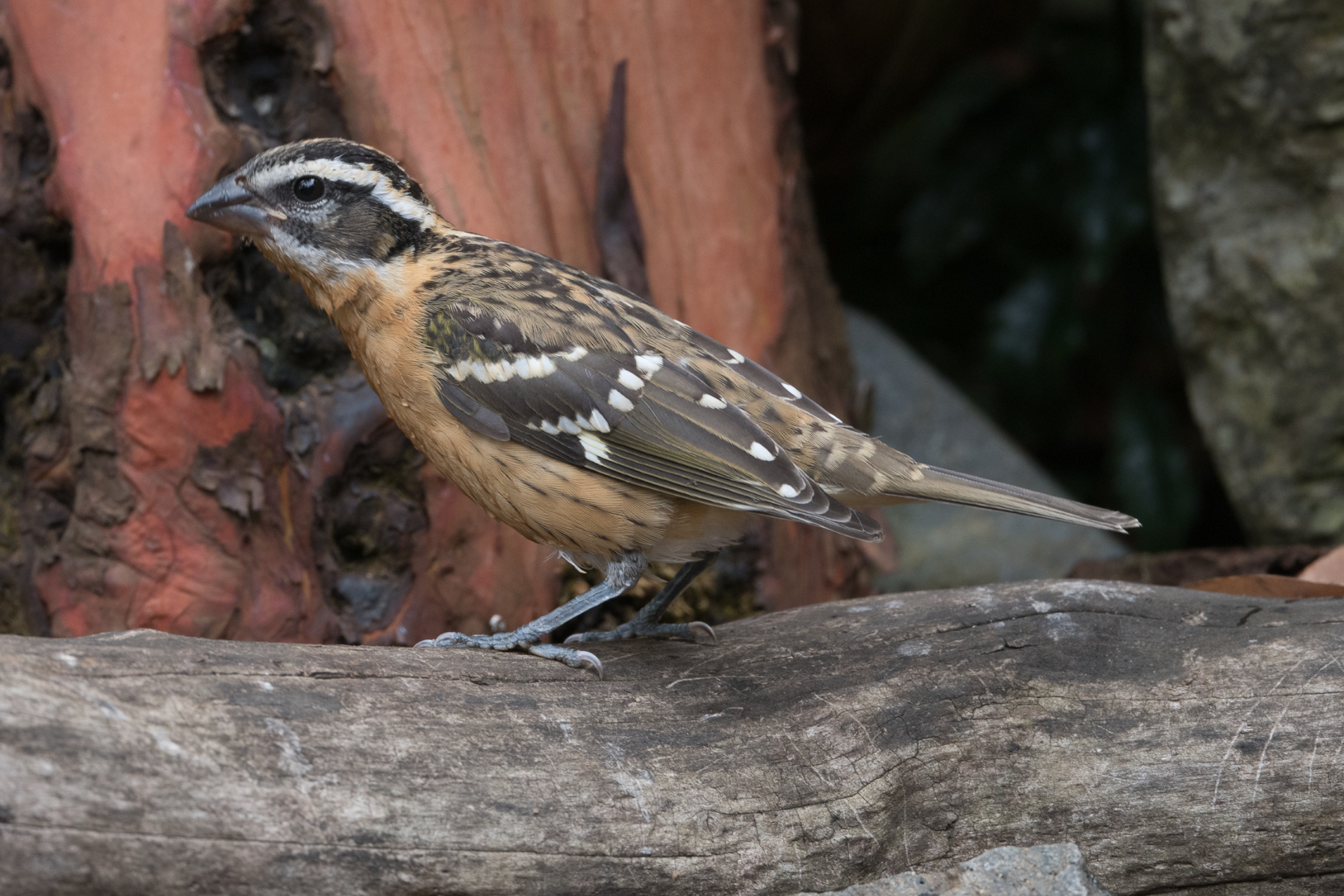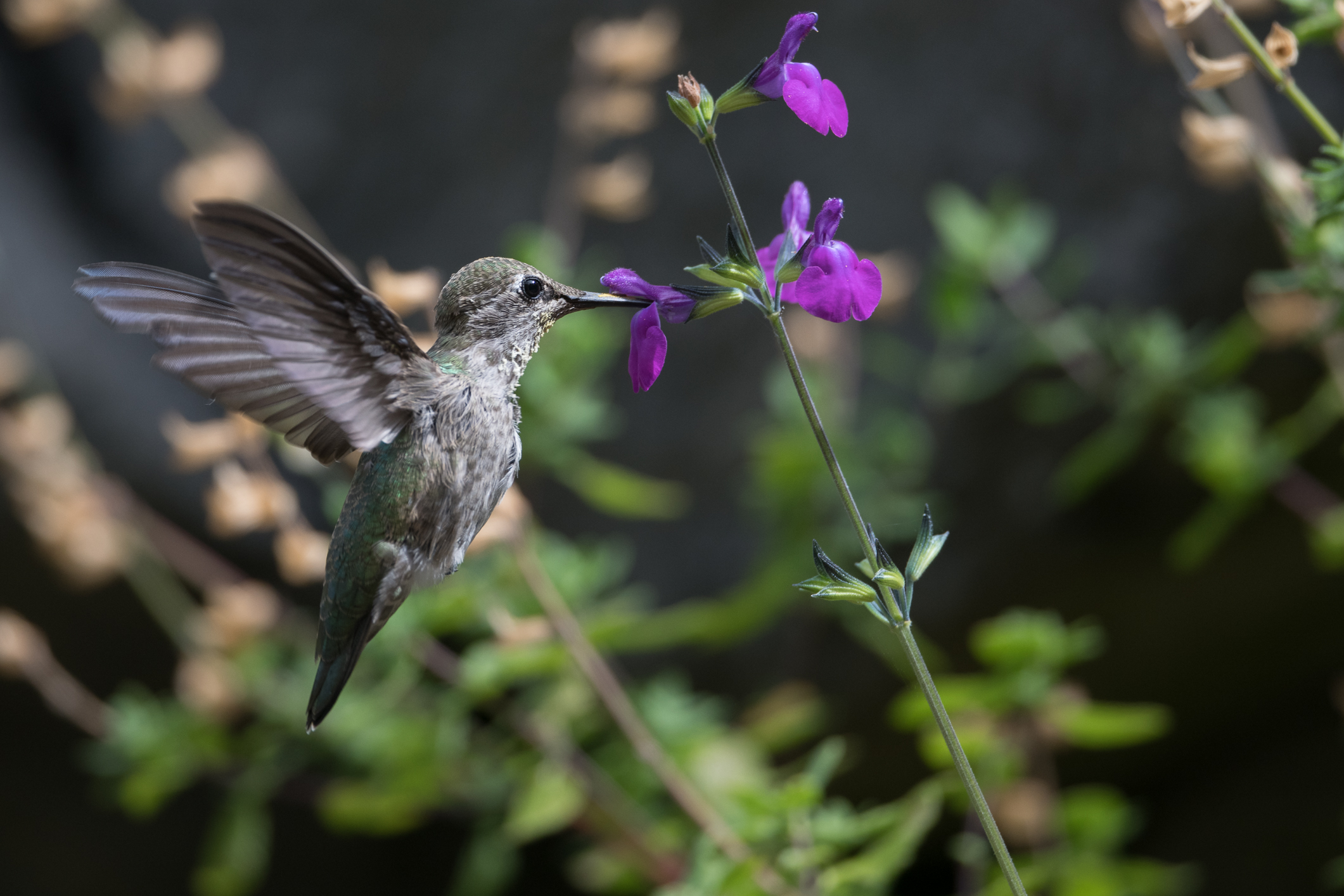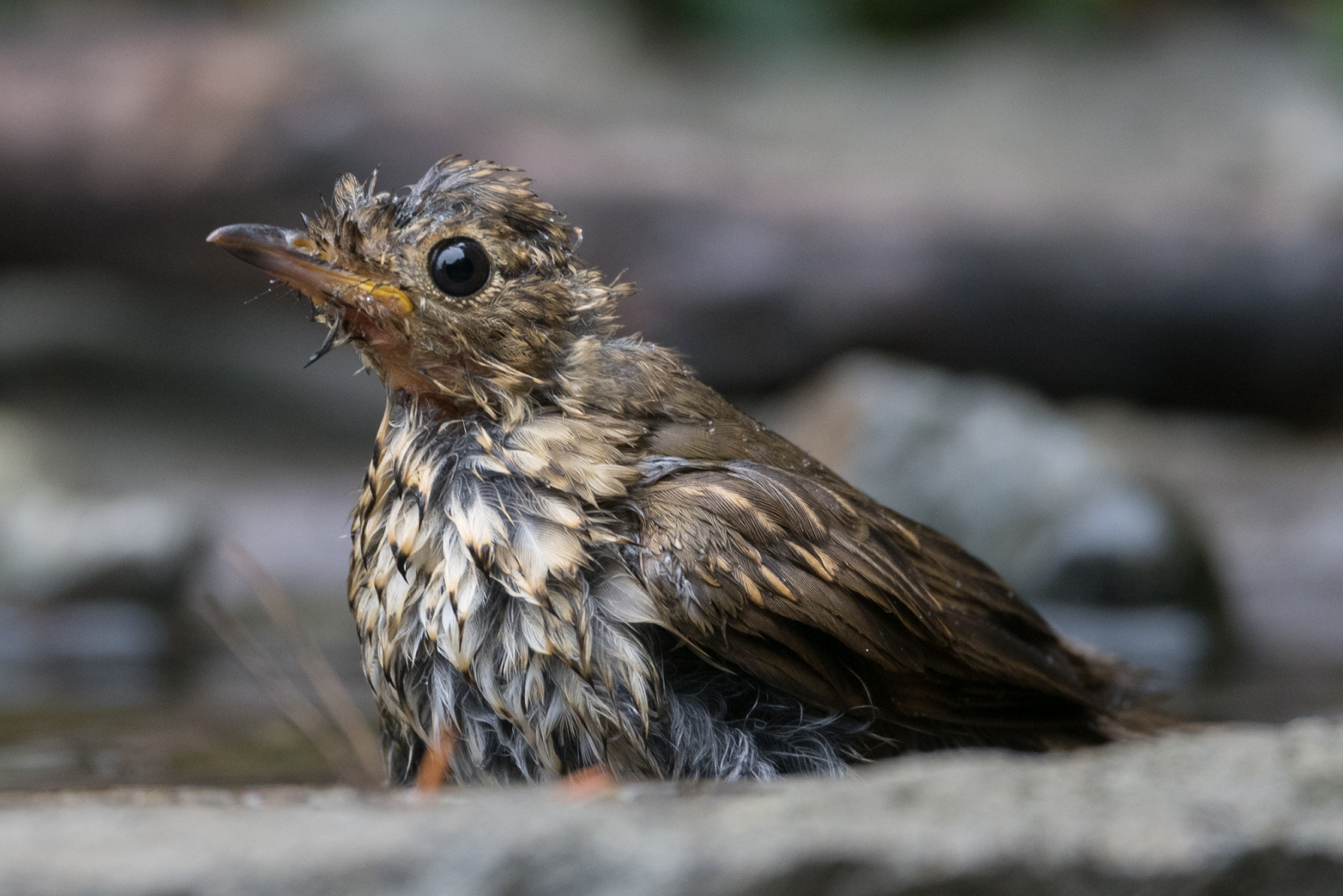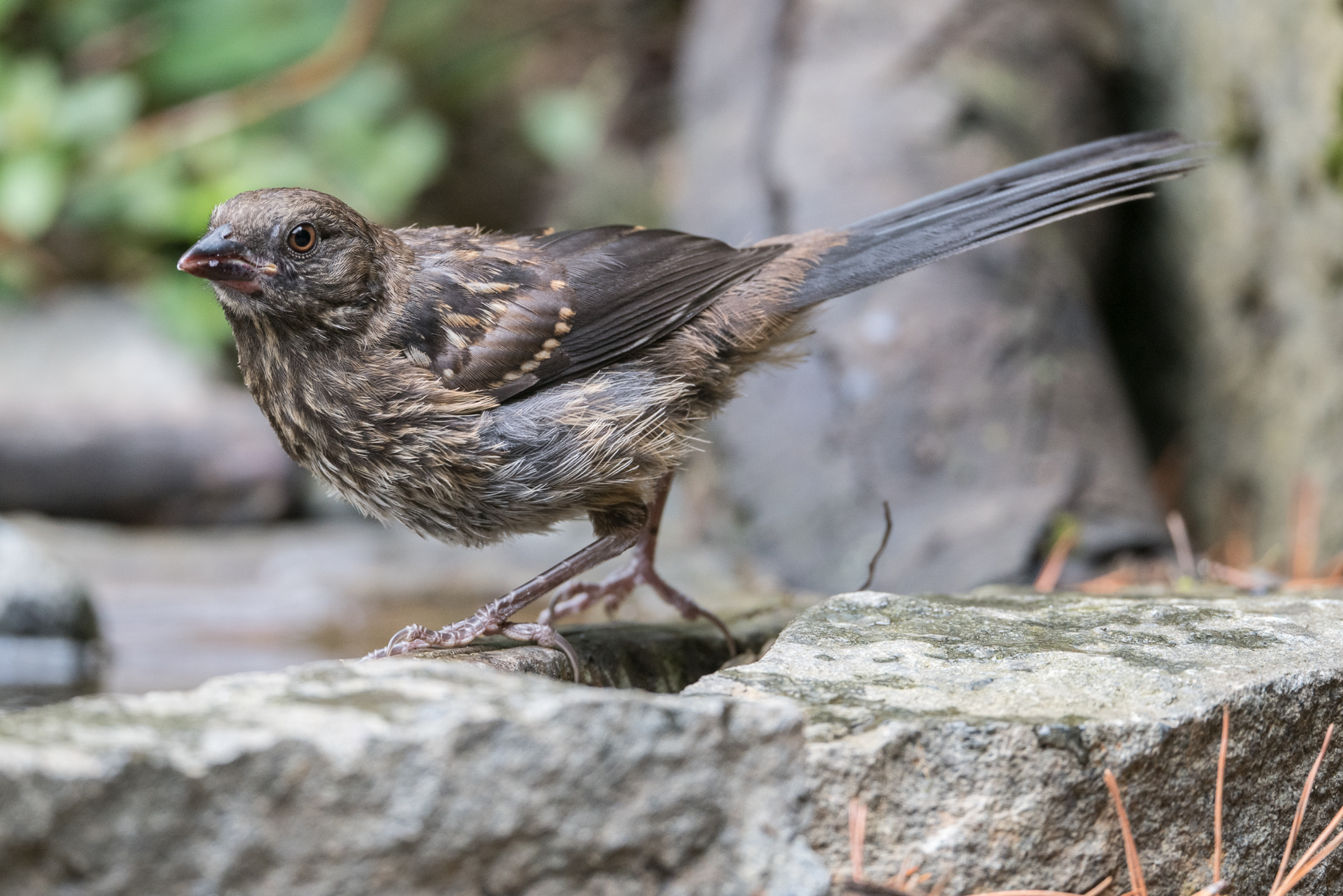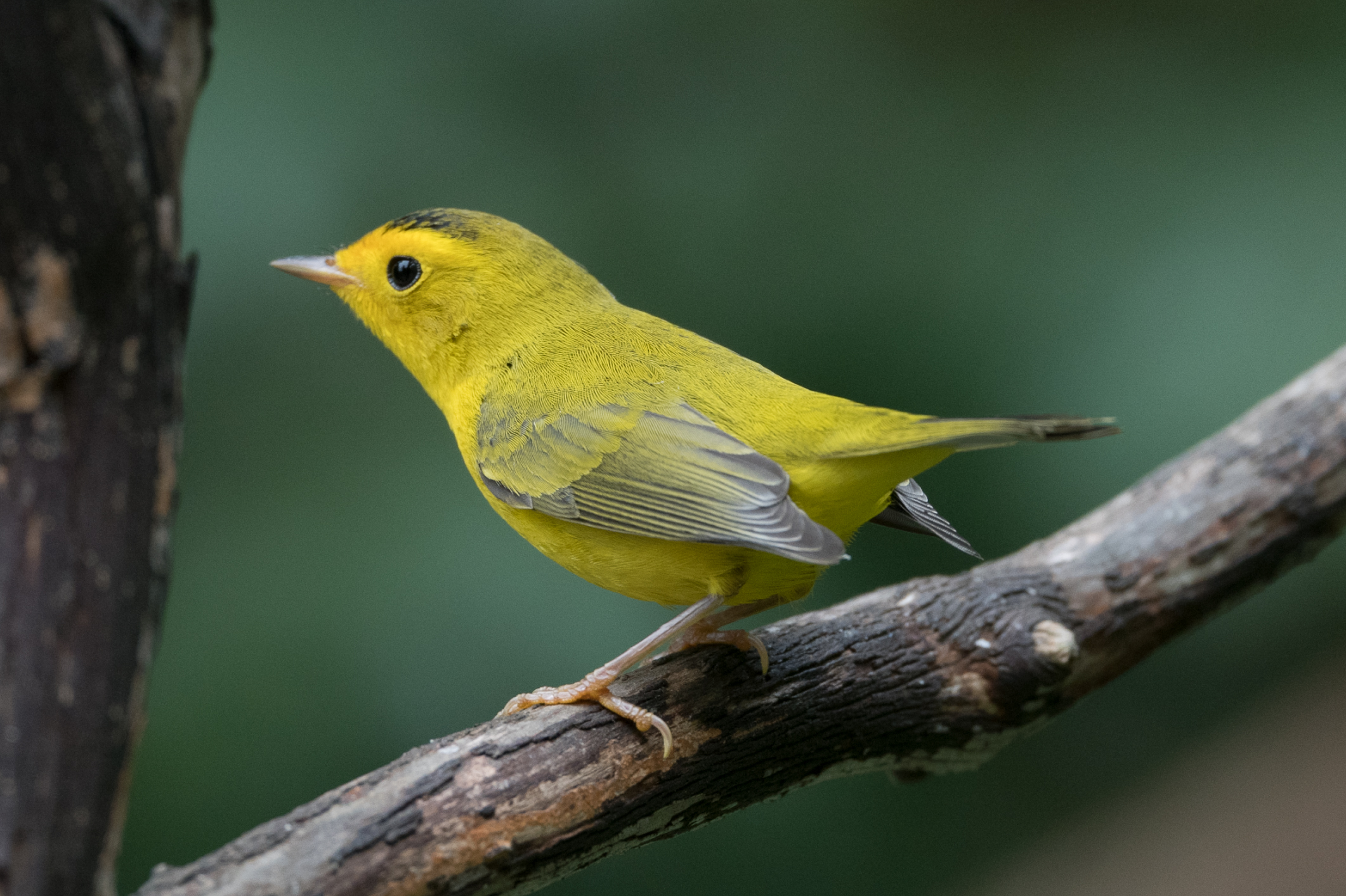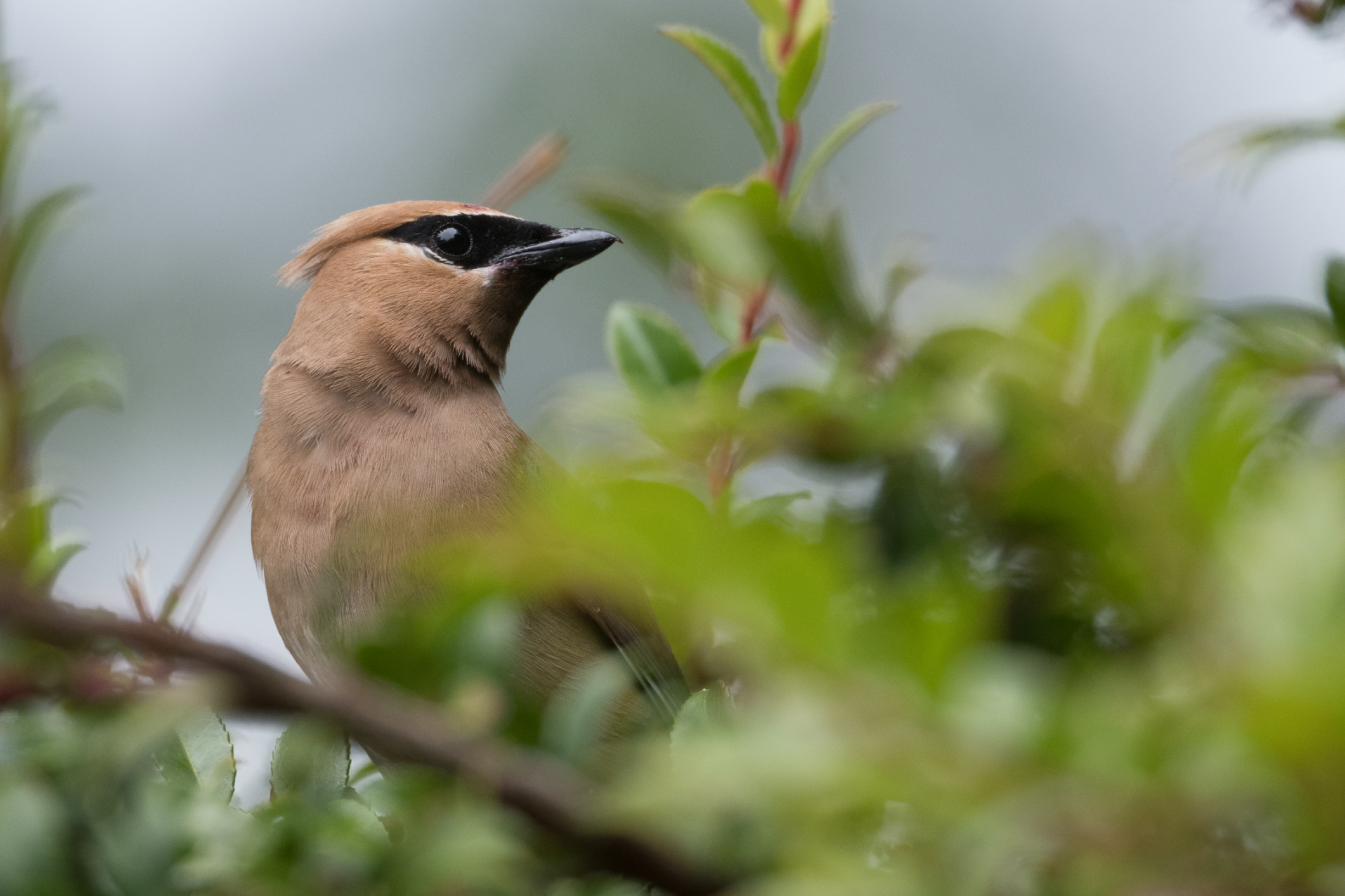
While most people living in the PacNW probably enjoy the sun, I find it detrimental to my bird photography. However, in the past two days (July 18-19, 2023) I’ve obtained some good photos of some of this year’s fledglings.
This is a Spotted towhee which has been extremely reticent to show itself for photos this year. It’s in transition from juvenile to adult plumage. Of all the bird species common in the area, I consider the plumage of the juvenile towhee the least like its adult plumage.
I’ve been patiently waiting for the opportunity to obtain good photos of our juvenile California quail. This year we didn’t see the juveniles until they were fairly large and I was unable to obtain good early photos of them for several weeks. On July 19, 2023, I finally had the opportunity to obtain some good photos.
I want to credit and thank my sister for assisting me with creating the new bird bath where these photos were taken. The construction of a bird bath for photographic purposes is a lot more complicated than you might think!
On this particulars day I had a rather rare observation… a female quail standing lookout while two males and about seven juveniles fed. It’s almost always the male that stands guard duty.
And here is the male on guard duty… but at this moment he’s distracted, performing a brief bit of personal grooming!
My photography has suffered over the past several weeks… full sun on most days. The sun introduces shadows which are caused by twigs, leaves and even the birds themselves. The sun also has a tendency to wash out colors and add contrast, all of which is not conducive to quality bird photography.
On July 8, 2023, we had an overcast morning so I spent some time in the yard with my camera. The sun broke out mid-afternoon but by then some of the yard was in shadow, so I had a second session in the yard later in the day.
Our yard has been devoid of what I consider interesting birds since the end of May. Among other disappointments, I haven’t seen a single warbler since May 31! We usually have a few interesting visitors during the summer but this year no waxwings, crossbills, flycatchers, vireos or other interesting birds are gracing our yard. We have had a wide variety of juveniles from successful breedings but to a great extent the sun has kept me from obtaining quality photos of the juveniles.
At the end of the winter we had a covey of some 18 California quail visiting the yard and we were expecting a banner crop this year, but the one or two coveys visiting the yard only have 3-5 juveniles, down from the 12+ we usually see. And this year we didn’t see the chicks until they were larger in size than in previous years. I was finally able to obtain some quality photos of the juveniles on July 8, but the juveniles are past the small chick phase.
This male California quail was performing sentry duty while the chicks fed…
Two of this covey’s four chicks were venturing out for a water break…
And this was the opportunity for a photograph for which I had been waiting for a few weeks…
The day’s overcast also allowed me to obtain some good photos of a few of our other residents.
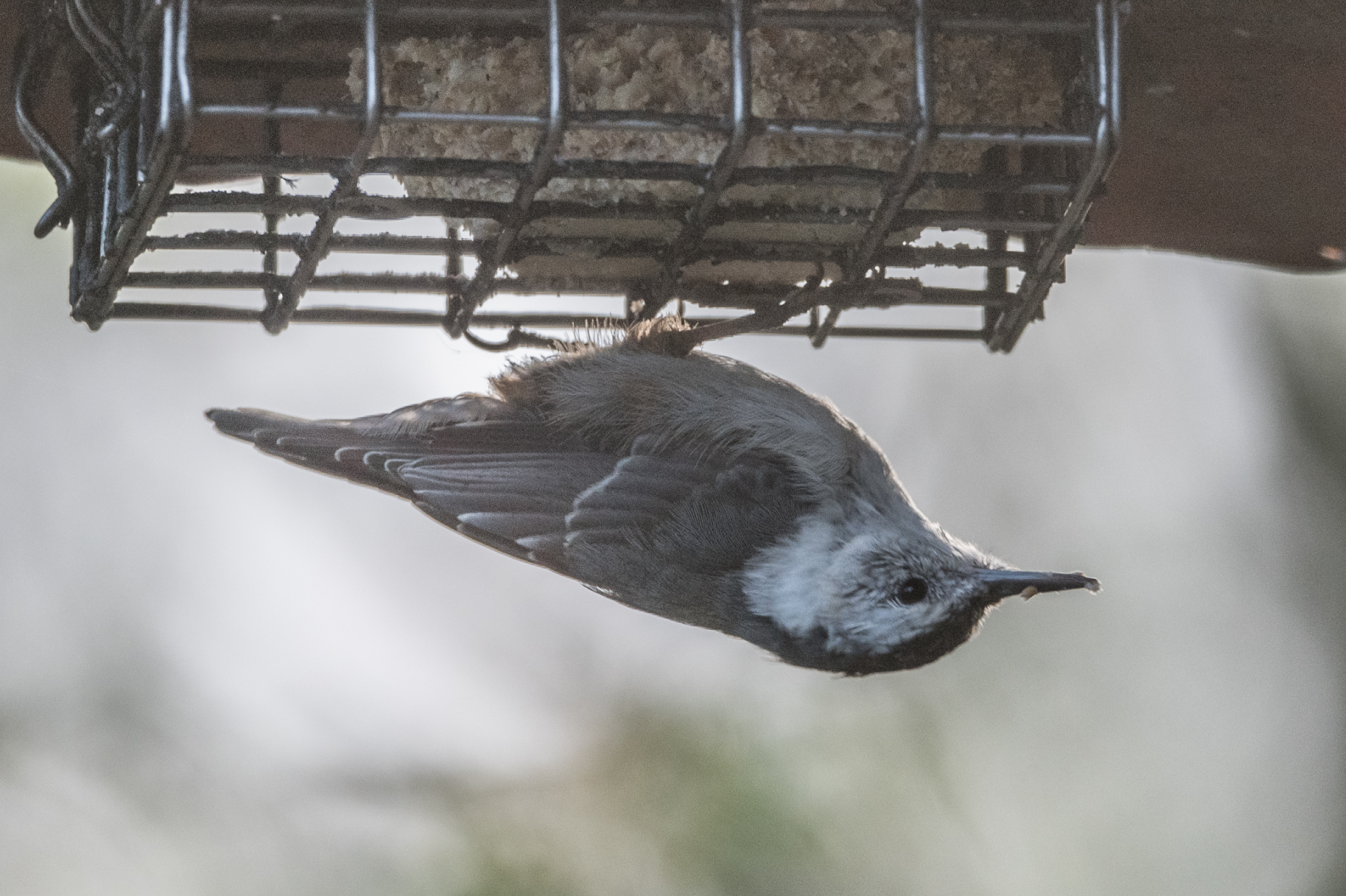
Red-breasted nuthatch…
Male juvenile Downy woodpecker…
Male American goldfinch eating salvia seeds
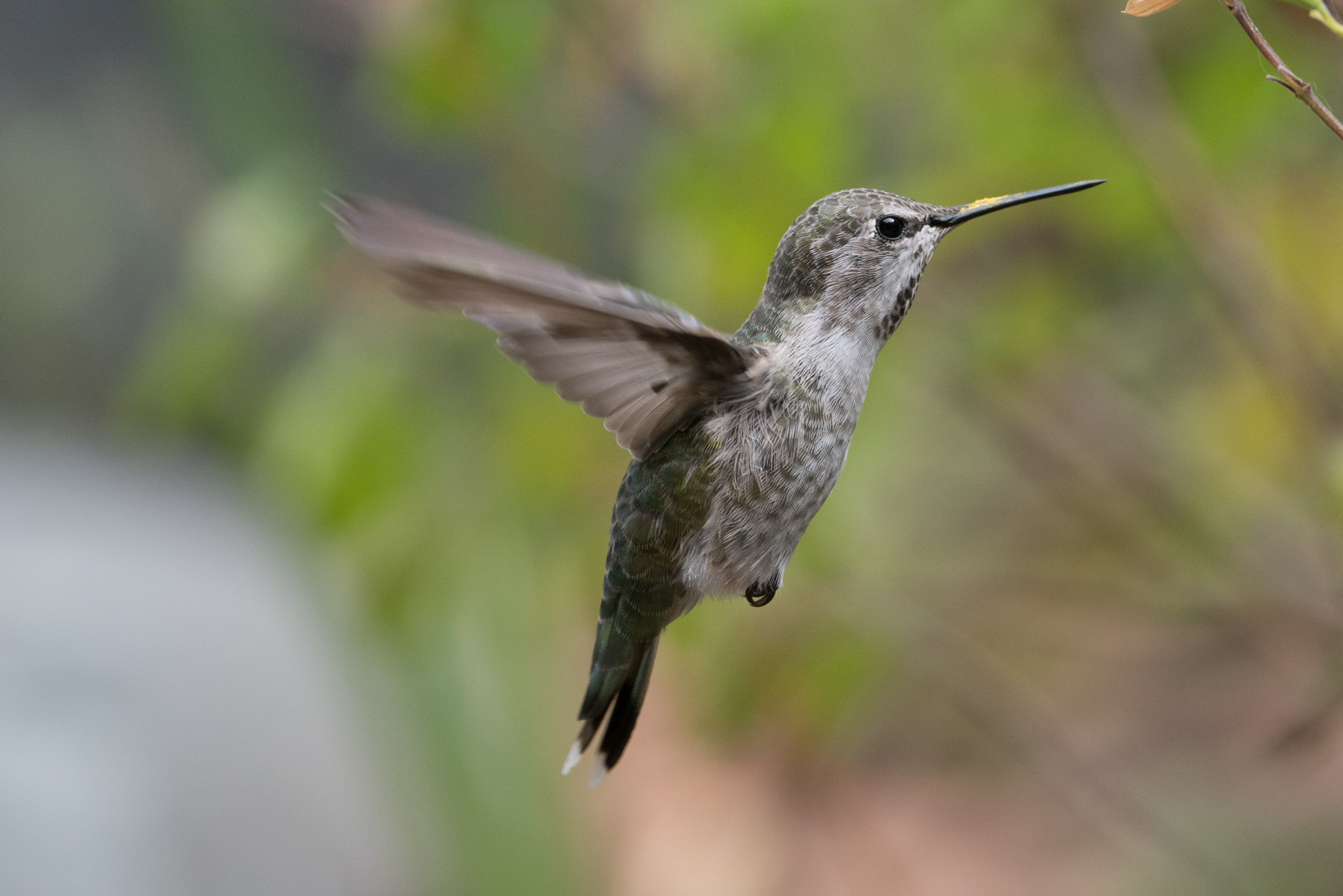
Male Anna’s hummingbird, probably a juvenile born this year…
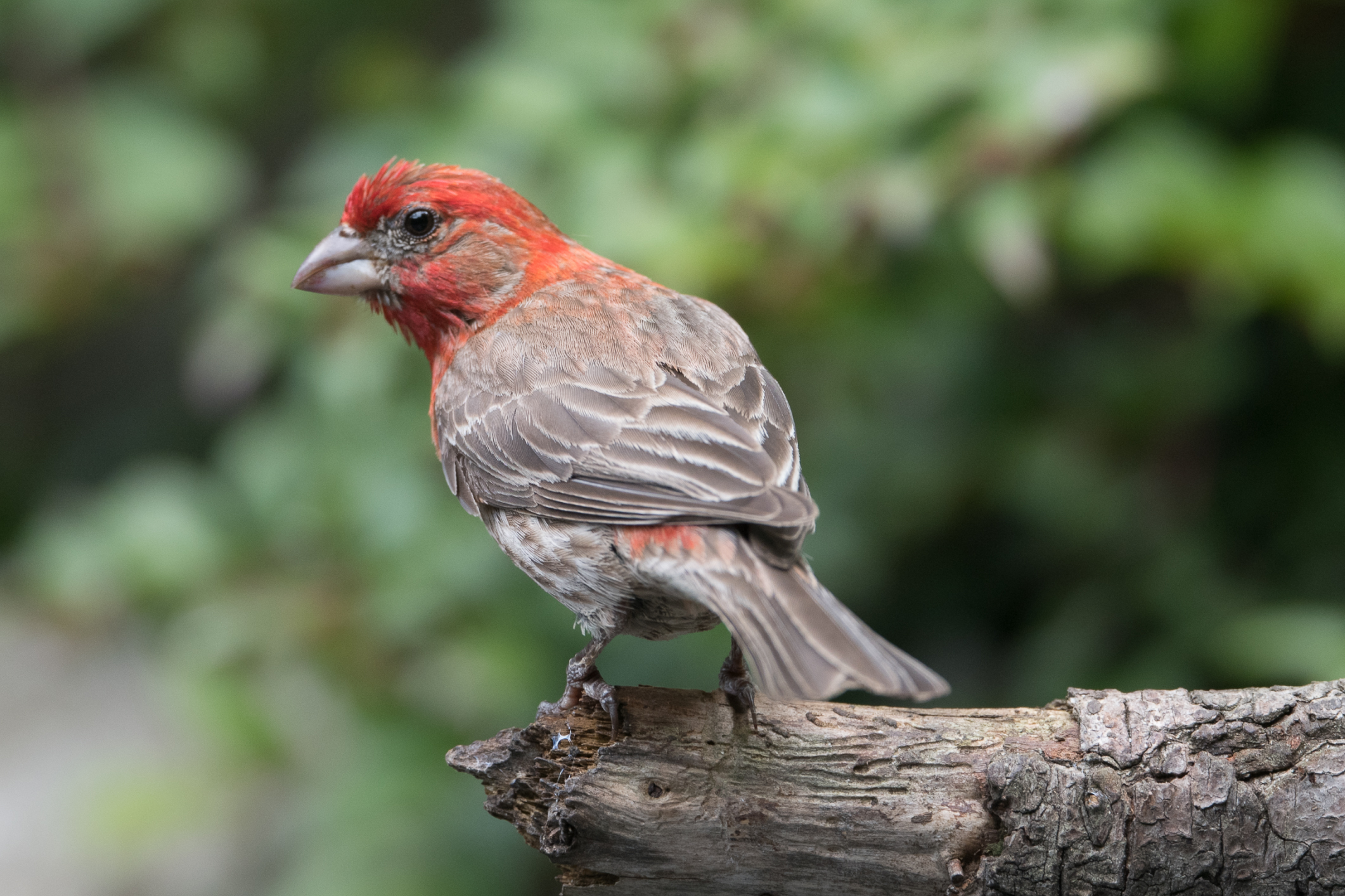
Male House finch…
For the past week or so we have had at least one Bewick’s wren that has been spending significant time in the yard. It’s been difficult to photograph because it almost never stops moving, spends most of its time undergrowth and hasn’t come anywhere near me…
Finally, I want to mention that on July 7, I made a trip to the Skagit Wild Bird Store and as I left the store I noted an American kestrel on a Memorial Highway power line near the store. I consider the species fairly rare in the area at this time of the year.
As in past years, we have a pair of House wrens using a nest box. It seems that the young should have fledged by now, but as of June 15, 2023, the parents are still feeding young in the nest box. I’ve spent some time observing and photographing the parents bringing food to the box and it’s been a real “eye-opener”! Photos haven’t been easy to come by because the birds are using a fairly dense Madrone tree adjacent to the box for their final staging point before quickly disappearing into the house, and I have been mostly dealing with full sun which provides unwelcome high contrast.
I have seen all manner of food in the birds’ beaks… a dragonfly, spider, grasshopper, two different kinds of caterpillar and something that appeared to be a group of insect eggs! My photographs in most cases, sadly, seem to be composed only of head shots with a few exceptions.
Here are some photos which document some of my observations…
And finally, what the Consumer Product Safety Commission might consider a choking hazard for a young bird!
It’s been at least six weeks since I last posted to my birding website and I’ve had two friends who have recently brought my lack of posting to my attention. So I’m providing an explanation and trying to get motivated to resume my posting activities.
This spring I became motivated to try to analyze/record our spring migration with regard to what I observed in our yard. (All references you see here will apply only to our yard and not the greater area of the Cap Sante Neighborhood, Anacortes or Fidalgo Island.) May has traditionally been our greatest month for migration so I designed a form for daily recording purposes, forms design having been one of the skills I cultivated and used in my employment as a payroll manager some 20+ years ago.
Despite my experience in both birding and forms design, my initial form failed to survive the first week of observations and I hurriedly resorted to trying to keep records with my cell phone. I think my efforts were successful… I’m still trying to convert/incorporate early May observations to the final format of the log upon which I decided.
To give you a little appreciation of my activities, I would try to spend some amount of time in the yard each day, generally mostly in the afternoons since that is when most of the bird activity seemed to occur. (This has always seemed strange to me because in Texas most of the activity occurred during morning hours.) My time in the yard was spent:
Trying to identify migrants in the mix of all the other birds moving around the yard.
Trying to photograph migrants for as long as they remained in the yard.
Trying to record migrant species, numbers and arrival times and without recording the arrival of the same bird twice. (Obviously, as bird watchers will appreciate, this is a highly subjective task!)
Some observations occurred outside my “yard time” due to sighting a migrant from inside the house… which in some cases would initiate “yard time”.
At the end of the day I would:
Attempt to edit my notes, in some cases reconciling them with photographs and time stamps.
Process photographs, which included deleting “non-keepers”, cropping, adjusting exposure-related issues, assigning a sex code when I could discern the difference, adding a quality rating code and renaming each photo to the species of the bird pictured.
To save time, in some cases I would send photos of special birds to family and a few friends in lieu of creating a blog post.
It was not unusual, on a good May migration day, for me to take well over 200 photos! So that, in somewhat more than the proverbial nutshell, is the tale of why there haven’t been any recent blog posts!
I’ll try to post some recent photos soon. In the meantime, if any readers are interested in habitat (as in yard) improvement to attract birds, staging your yard for birding photography, birding photography techniques or use of Adobe Lightroom, feel free to contact me. These activities are a daily happening here!
I want to thank two friends, Mark and Phil, for prodding me to resume posting. It’s still going to be slow going for a while because birding-related projects aren’t the only ones on my plate!
For the last couple of weeks in April, 2023, I had been worrying that there hadn’t been the number of warblers coming to the yard that I expected. For the last week or so in late April I had been monitoring the yard fairly closely, especially in the afternoons. I spent some of my time developing a form I could use to document daily migrant arrivals during the month of May, our heaviest time for migrant influx.
To recap, I observed my first seasonal arrival (s) on April 16 and 17, 2023. Both observations were of a single Orange-crowned warbler, and of course I have no way of determining whether or not it was the same bird. On April 24 things took a dramatic turn when a Townsend’s warbler showed up, explored the yard and took a bath. I was able to obtain over 70 photos of the bird! I was encouraged that this was the exciting beginning of our migration arrivals. But I had yet longer to wait.
On April 25 I discovered a dead Orange-crowned warbler, apparently the result of a window kill… but still no large influx.
Following two warm, sunny days with no sign of migrants, April 30 dawned much cooler with cloud cover and some early very minor precipitation. My unfounded optimism at this point was that the birds had had two wonderful days for migration and that they might now be ready for rest, food… and a bath!
I began my yard monitoring on April 30 at 1:20pm. At 1:30pm I had my first migratory visitor of the day… an Orange-crowned warbler (OCWA). These are actually year-round residents, but our number of sightings rise significantly in the spring and summer.
I’ve set out my observations for the afternoon below. My documentation is based on VISITS since in most cases I have no way of distinguishing one bird from another… even using photographs. This is especially true with OCWAs. I did manage to determine from photos that the Audubon’s warblers (AUWAs) were different birds.
To speed my documentation I’ve been trying to learn and use established abbreviations for species. Here are the abbreviations for the species listed below: OCWA – Orange-crowned warbler; WIWA – Wilson’s warbler; AUWA – Audubon”s warbler.
1:30 – OCWA
1:40pm – OCWA
1:55pm – OCWA (2)
2:05pm: AUWA (m), OCWA (2)
2:20pm – WIWA (m)
2:40pm – OCWA
2:50pm- OCWA
3:00pm – AUWA (m)
3:10pm – OCWA, WIWA (m)
3:15pm – OCWA, WIWA (m)
3:25pm – OCWA
I left the yard at 4:20pm, after three hours of observation. But wait… there’s more! (Where have we heard that before?). My new office remodel gives me a good view of a couple of our water features, including our watercourse. While processing the afternoons photos in my office I had the following observations:
4:55pm – OCWA
5:50pm – OCWA
6:05pm – OCWA
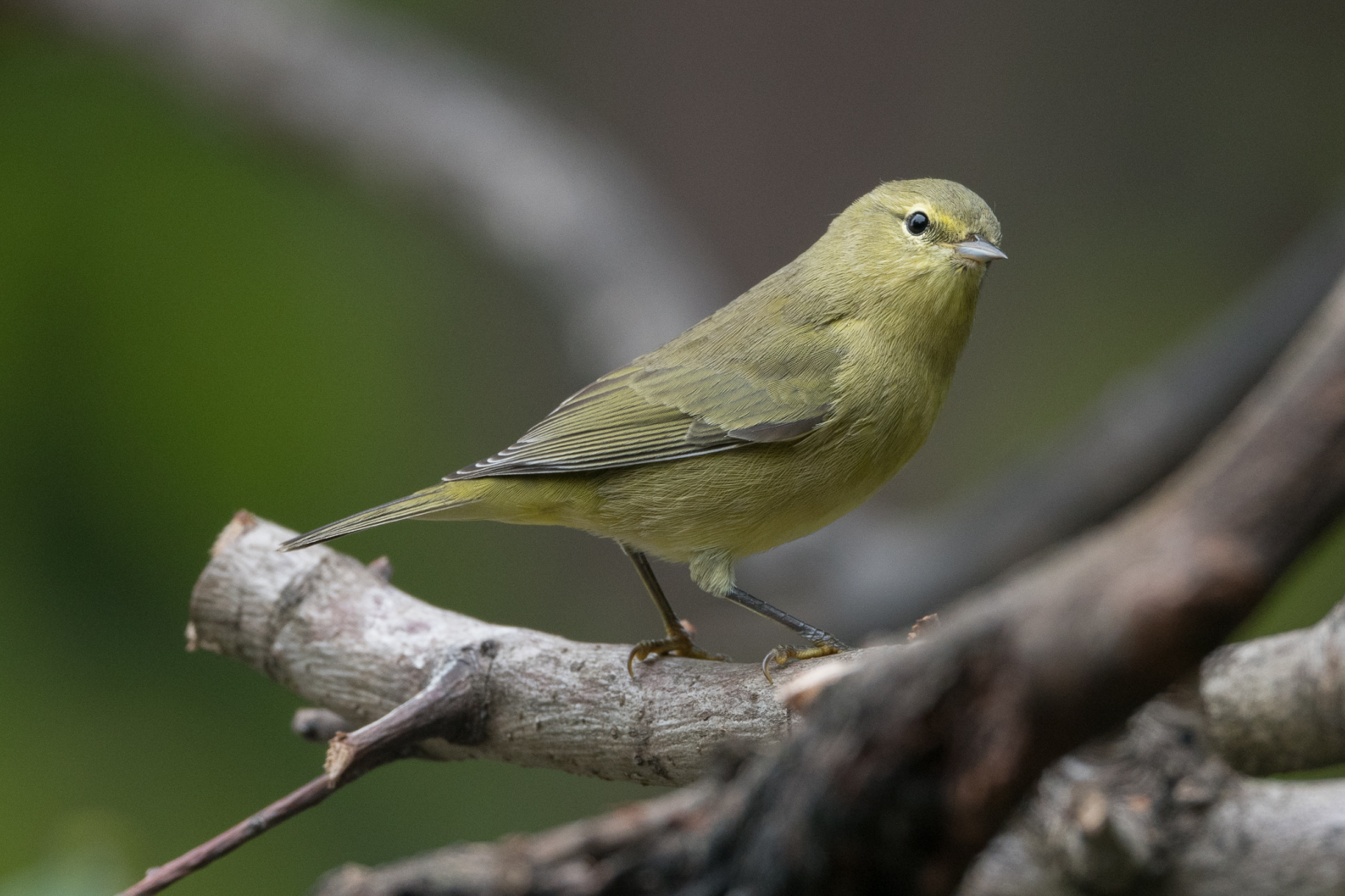
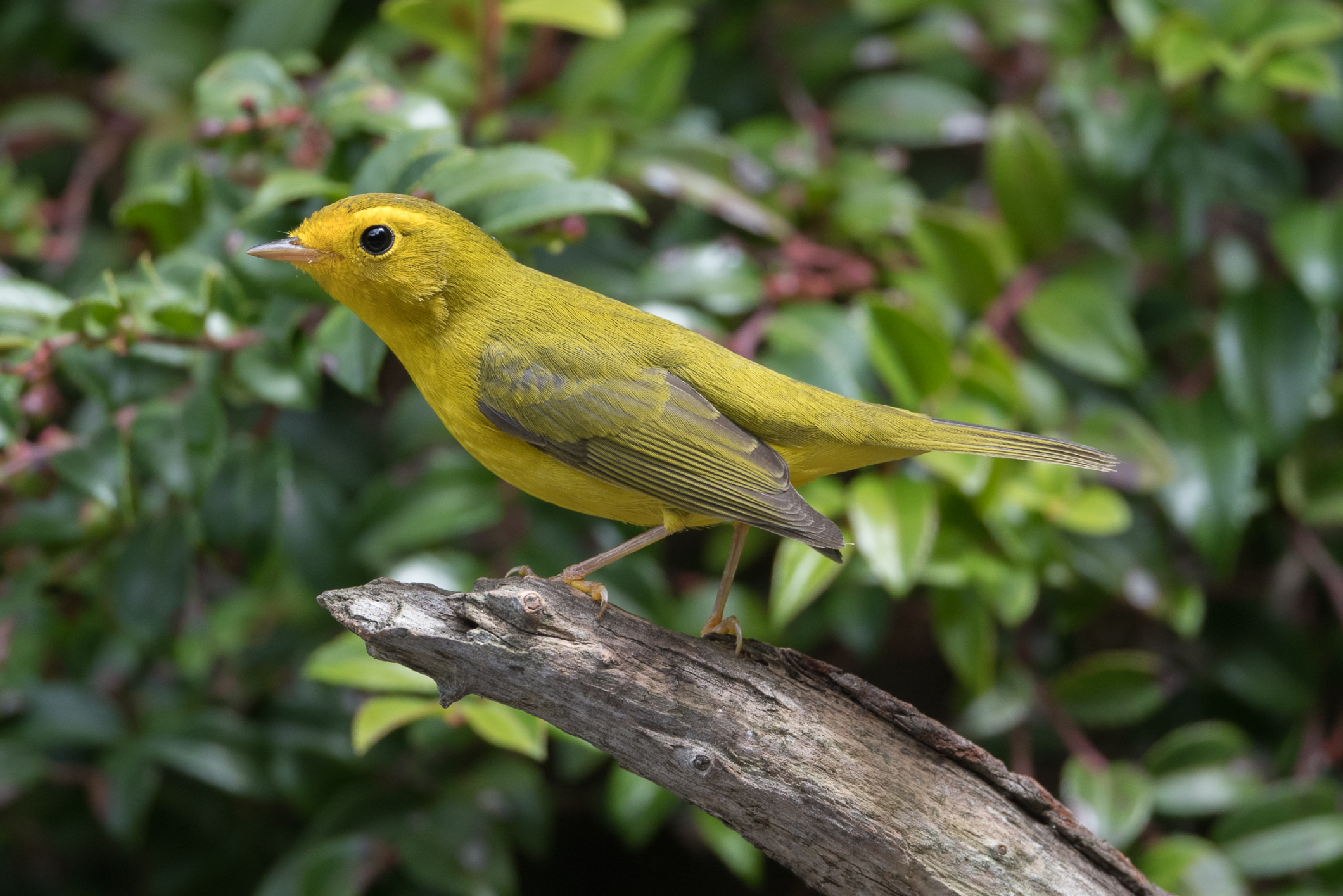
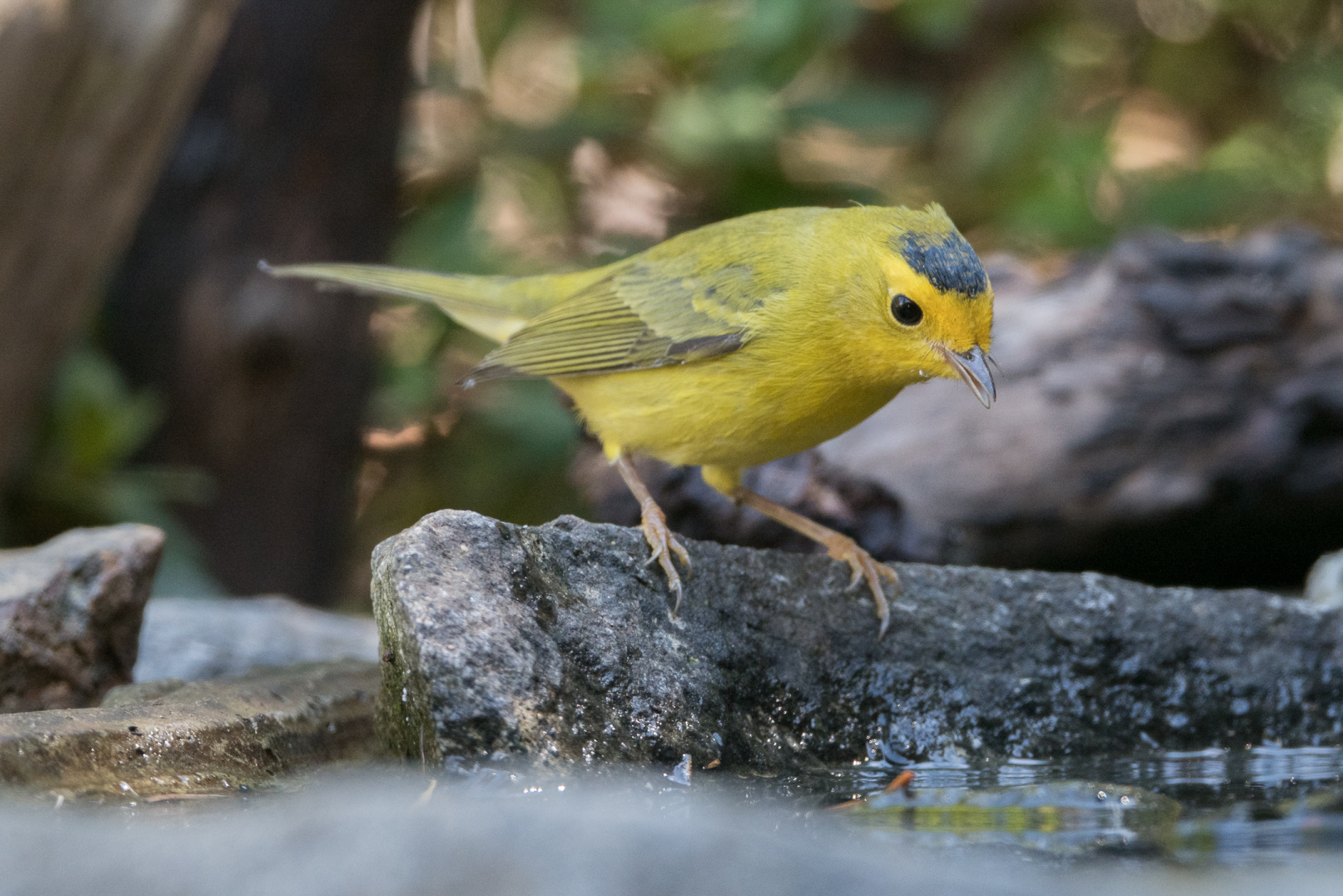
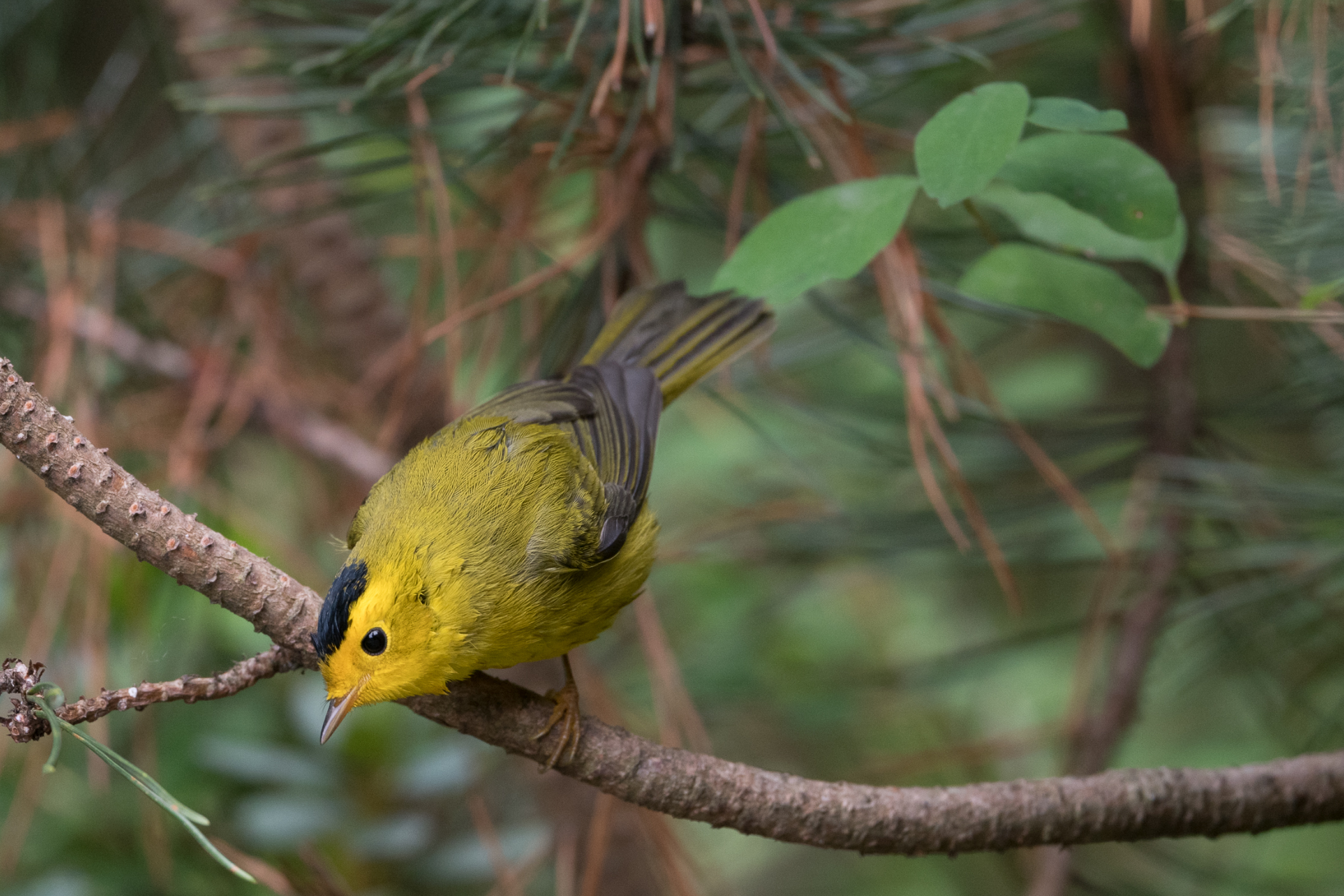
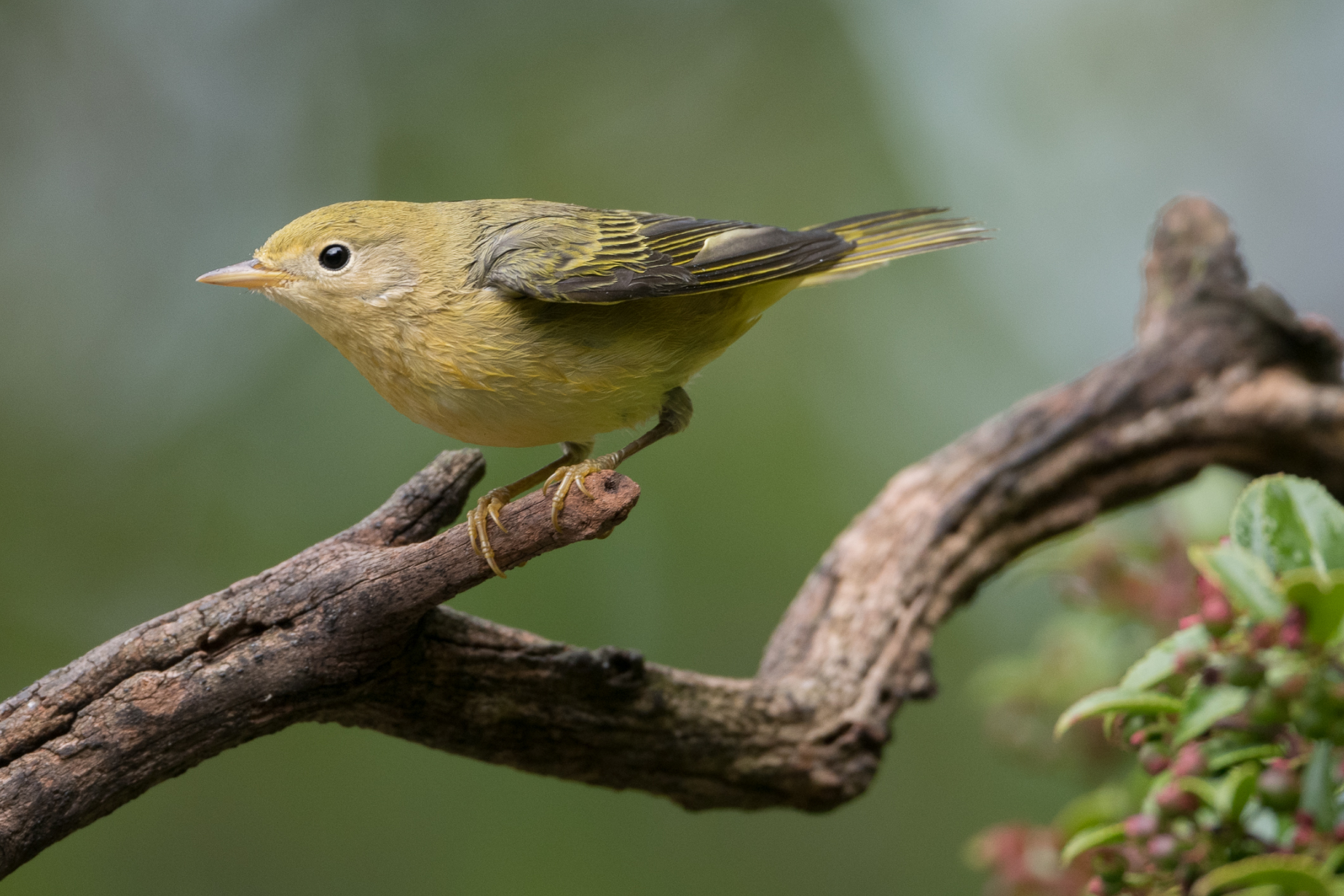
Tallying the day’s observations, I had two male AUWA visits, three male WIWA visits, and at least 12 OCWA visits. I didn’t keep tabs on how many photographs I took, but I obtained good photos of all three species of warblers that visited. Some of those photos appear below…