Whine, Whine, Whine!

As most of you realize, I consider my photographic specialty that of photographing birds.  I consider myself only an average photographer and only an average birder.  It’s not until the two pursuits are combined that my skills become a little more unique.  

With regard to photography, most photographers get to either choose or manipulate most factors in the taking of their photographs.  They might choose the time of day, the angle of their shots, their exposure and shutter speed and in many situations they also manage to manipulate their subjects… framing the shot and background, posing subjects and adding light through various means.  Unfortunately, these are all techniques and tools that are usually beyond my reach. 

The birds that I photograph dictate the conditions under which I am able to photograph them.  I usually have to contend with many factors that are beyond my control…

·         Location or setting where I find/photograph the bird,

·         Time of day when I find the bird,

·         The available light (in the broadest sense)

·         The bird’s posture and/or activity,

·         Limited time for photographs due to the bird’s movement,

·         Increased shutter speed to eliminate blur,

·         Reduced aperture for correct exposure to offset increased shutter speed,

·         Intervening leaves, branches or twigs (which can make focusing a challenge),

·         Shadows cast on the bird by the aforementioned objects as well as shadows cast by the bird’s own anatomy (especially beaks). 

I can occasionally ameliorate, to some degree, some of these factors, especially when I perform photography in my own yard.  When I’m outside my yard my influence is reduced from a low level to an almost non-existent level. 

So all of this is an explanation as to why I’m not posting any first-class photos this week.  But here is what I managed to obtain…

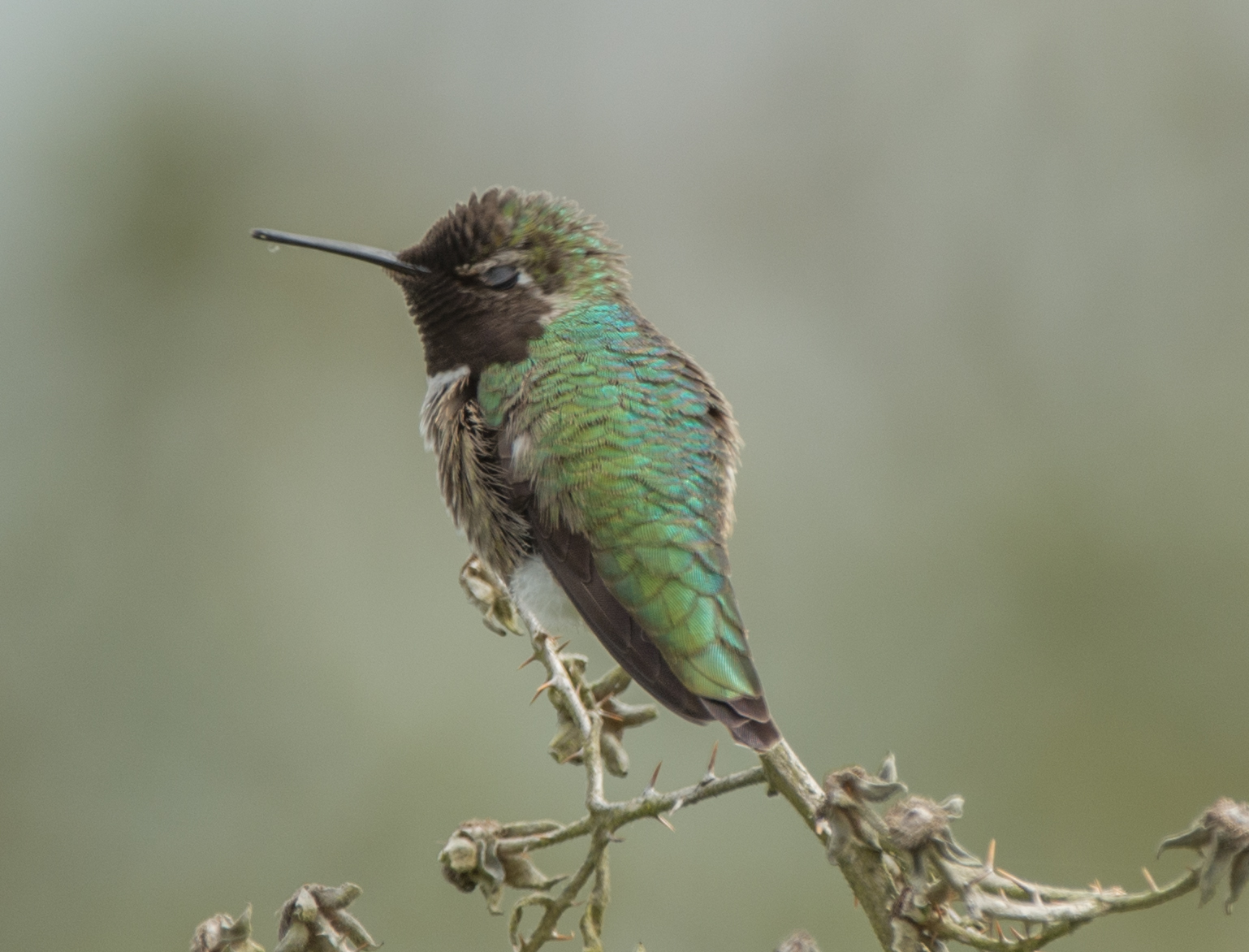
A male Anna’s hummingbird, presumably the one that over-wintered with us this past season.  In this case he’s visiting our watercourse for a bath, an activity that apparently only takes place once or twice a day.  The bird is very elusive, visiting a feeder from time to time but never lingering and usually being chased off (intimidated) by Rufous hummingbirds which seem to not appreciate his presence at the feeders.  In the first photo I didn’t have good light and the contrast between the bird and background is rather low so that the bird doesn’t stand out.  I am having to take the photo at a shutter speed of 1/250 of a second, somewhat slower than I would like and still have to add considerable light through my processing with Adobe Lightroom.  It would be nice to see the birds gorgeous gorget at just the right angle for full display, but as I’ve already intimated, I don’t get to control that, so what we get is only a portion of it. 

 Hummingbird, Anna's  20140406-01

 Hummingbird, Anna's  20140406-03

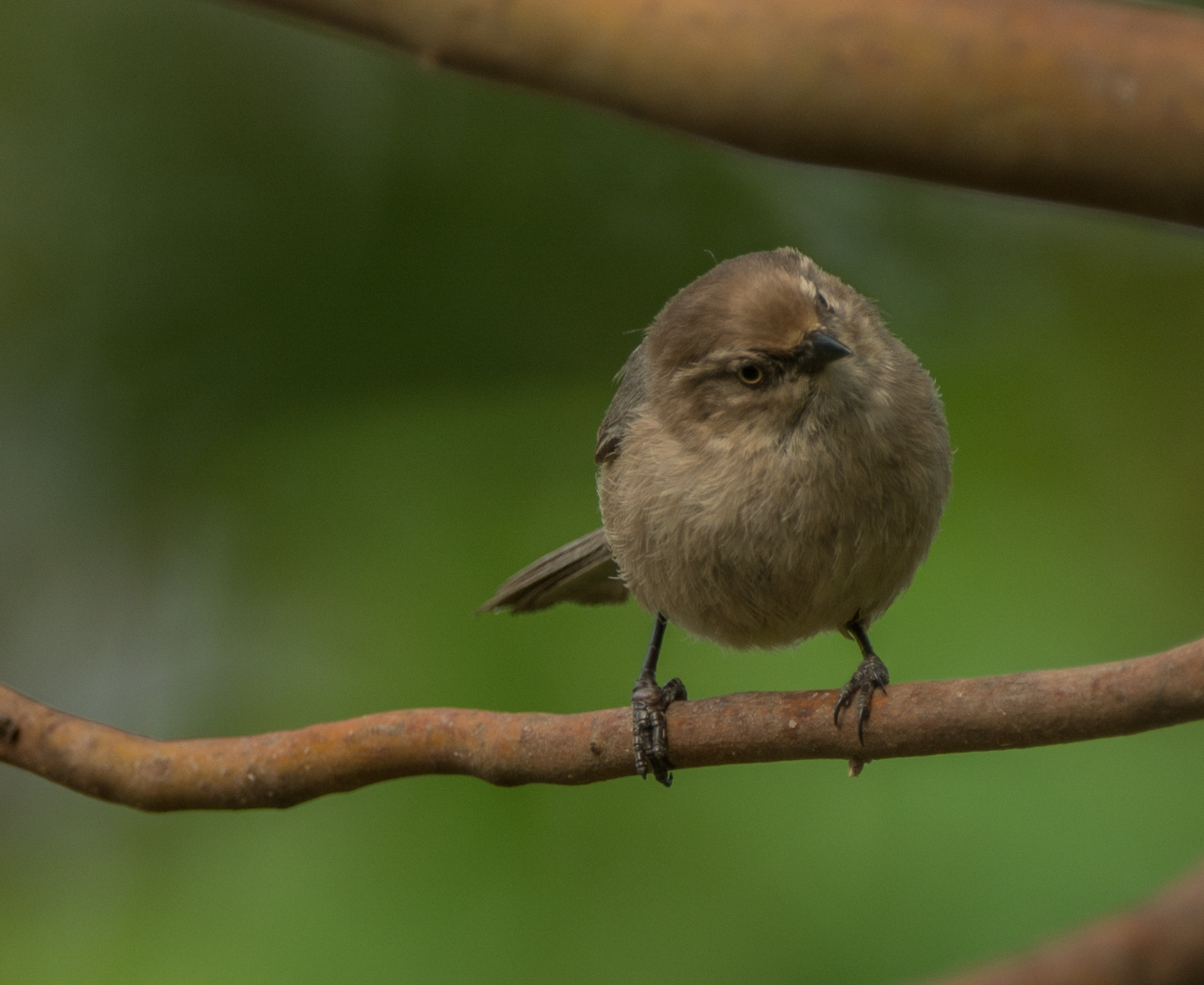
Next up, a female Bushtit I found in a small wetland area on Cap Sante.  This was a female and her presumed mate was in the area.  Unfortunately I spent a long time stalking this bird and only obtained a very brief opportunity, under conditions that were unfavorable for many reasons, to take some quick photos.  The main problem in this case was lighting (the bird is side-lit) and I probably would have obtained a photo with more detail had I been able to use a higher shutter speed.  I have much better photos of Bushtits (see prior blog posts) but this photo represents some of the challenges I face. 

 Bushtit  20140407-07

Finally, here is a photo of a Ruby-crowned kinglet photographed in low light conditions in the same area.  Like the Bushtit, I spent considerable time waiting for an unobscured opportunity to photograph this bird, and when I was able to obtain two photographs (which are virtually identical) it was in very low-light conditions.  I managed to capture some detail but had to rely on Lightroom to obtain anything like a usable photograph. 

Kinglet, Ruby-crowned  20140407-01

More Time in the Yard

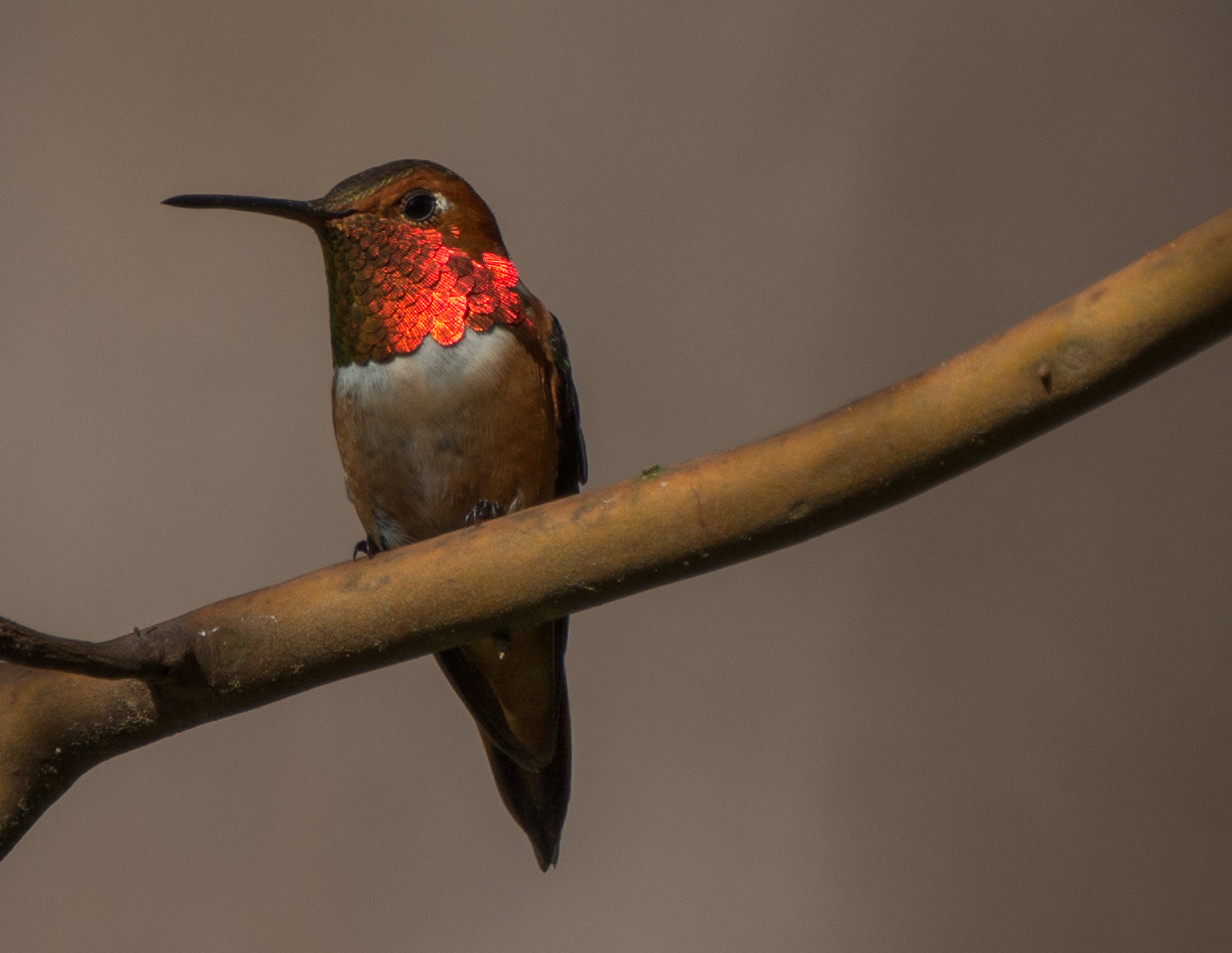
I keep hoping for a spring migrant or two, but thus far it just isn’t happening. The one exception are the Rufous hummingbirds.  We have at least one male and probably 3-4 females.  And our male Anna’s hummingbird, presumably the one that overwintered with us, is still visiting the feeders but is difficult to photograph.  And he’s proven to be personal non grata to the Rufous hummingbirds.

Hummingbird, Rufous  20140402-07 Hummingbird, Rufous  20140402-04 DSC_3316

So no other new arrivals, but several birds will be leaving the yard soon.  This Golden-crowned sparrow, along with a couple of associates who overwintered in the yard, will soon be leaving us for more northern breeding grounds.  As you can see from the bird’s crown, the plumage is in a transitional stage and we probably won’t get to see the bird in its full breeding plumage.

Sparrow, Golden-crowned  20140402-03

Yesterday I found 2-3 sub-adult Bald eagles soaring over the Cap Sante viewpoint.  They were circling in the wind currents making them easy to photograph.

DSC_3271

And finally, this is probably the best photo of an Eastern Gray squirrel I’ve ever taken.  I would have taken more but I only rented the squirrel for an hour and had to get it back to the taxidermist!

Squirrel, Eastern Gray  20140402-01


Neighborhood Eagles

We had a nice break in the weather on March 31, with the day alternating between sunny skies and a slight overcast.  It was a welcome change in a month that saw Seattle set an all-time record rainfall for a March month.

It should come as no surprise that I took time to sit outside in the yard with my camera.  Yard activity was much slower than I had anticipated.  As I sat I noticed a crow making a couple of passes at the top of a very tall fir tree located a couple of hundred feet outside our property.  I focused my lens on the tree top and saw a Bald eagle sitting in the top of the tree.  The eagle was a long ways away and mostly obscured by fir needles, but I took a couple of photos and as I did a second eagle flew into the top of the tree.  This generated some posturing and flapping of wings for the newcomer to adjust its balance.

I took a couple of more photos and then a third eagle flew in, and this third arrival upset the balance of nature!  There was a lot of posturing and screaming before the third eagle decided it might be best to leave.  The eagle flew directly towards me when it left, but unfortunately all of  this happened rather unexpectedly and I didn’t have the time to optimize the settings on my camera for focus and shutter speed.  Nevertheless I obtained some interesting photos…

Eagle, Bald  20140331-03 Eagle, Bald  20140331-04 Eagle, Bald  20140331-10 Eagle, Bald  20140331-11


Hamming It Up!

I try to discourage birds from posing for me, but some recognize me and figure that they have a better chance of being immortalized in my blog by striking a pose.  So in this instance I’m going to humor a few of them…

A male Brewer’s blackbird demonstrating his balancing stance.  (I could probably perform the same trick if I had a base like he has!)

Blackbird, Brewer's  20140327-19

A male American wigeon…

Wigeon, American  20140327-10

A Great Blue heron…

Heron, Great Blue - with reflection 20140327-03

And finally, the biggest ham of all… a Black oystercatcher…

Oystercatcher, Black  20140327-04

Waterfowl & Shorebirds

Over the past week or so I’ve made several photographic/birding excursions but have failed to post any photos.  So here are some water-related photos…

DSC_2186 On the same day I photographed this gull who was bypassing mussels in favor of a larger meal…

DSC_2271


On March 20, I toured March Point and found a female Bufflehead very close to the shore.  This allowed me to get some very nice photos.  I returned the next day and there were four female Buffleheads in the same place, and before I left (after taking many photos) all four had walked up on the rocky beach.  This was the first time I had ever seen a Bufflehead out of the water!

DSC_2354 DSC_2352

And today (3/25/2014), I spend some time down on West Beach on Whidbey Island.  Having some patience and a little luck finally netted me two Black oystercatchers which flew onto a rock in front of me.  I obtained probably the best oystercatcher photos I have in my portfolio, with the oystercatchers eventually walking within about twenty feet of me as I leaned against a rock and photographed them.  I also saw a lot of other waterfowl.

I’ll leave you with this silhouette of a gull landing on a rock…

DSC_2820


MMM


d this Common loon, in breeding plumage, in the Swinomish Channel last week.